




 Matthew J. Carberry, USA

Info
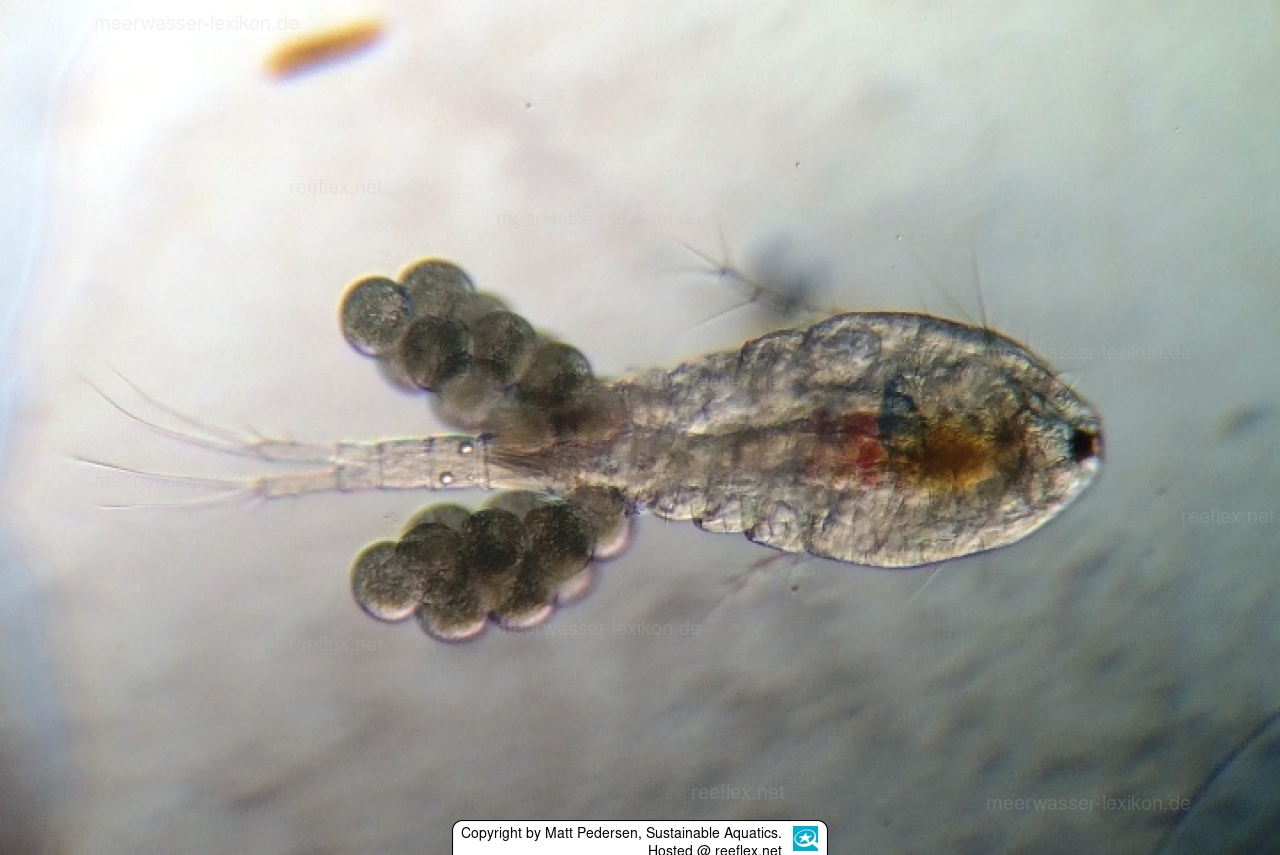
Apocyclops panamensis belongs to the zooplankton and is readily eaten by filter feeders (corals, tubeworms, mussels, sea anemones) and also by fish.
This coepod species is suitable for various fish larvae as it is pelagic (free-swimming).
Size
nauplii approx. 80 µm
adult cops approx. 200 - 600 µm
Food for optimal copepod reproduction.
Isochrysis galbana
The slight turbidity caused by the addition of the algae should dissipate within a few hours.
Caging.
Best kept in a reactor or bucket with constant not too vigorous water movement to keep the pelagic nauplii suspended in the water column. Slight sedimentation should not pose a threat to the culture.
Reproduction rate.
Reproduction rate is based on density/salinity, feed quality, feed density and temperature.
Contamination
Contamination with Brachionus plicatilis can occur by no filtering with a sieve, as both species live in the same size spectrum. It is best to start a new culture, either with new acquisition via the trade or a separation of individual copepods, but is only advisable with a microscope so that no Brachionus is pipetted along.
Use as rearing feed.
Initial feeding of copepods to larval fish and crustaceans has a better starting point in skeletal deformations, pigmentation, survival rate and the growth rate in the larval stage.
The copepods generally have.... higher levels of eicosapentaenoic acid (EPA) and docosahexaenoic acid (DHA) and arachidonic acid (ARA), as well as iodine* than enriched brachionus and Artemia. Of course, feeding different species of algae to copepods can still bring improved nutrient requirements per larval species.
*Iodine
Is an important component for the production of thyroid hormones and metamorphosis. Depending on the copepod species, the proportion can be up to 700 times higher than in Artemia.
Breeding preparations
Starter cultures and breeding instructions for these copepods are available on the internet.
see further links
Synonyms:
Apocyclops panamensis tannica (Davis, 1948)·
Cyclops panamensis Marsh, 1913
Cyclops panamensis tannica Davis, 1948
Metacyclops panamensis (Marsh, 1913)
Microcyclops panamensis (Marsh, 1913)
This coepod species is suitable for various fish larvae as it is pelagic (free-swimming).
Size
nauplii approx. 80 µm
adult cops approx. 200 - 600 µm
Food for optimal copepod reproduction.
Isochrysis galbana
The slight turbidity caused by the addition of the algae should dissipate within a few hours.
Caging.
Best kept in a reactor or bucket with constant not too vigorous water movement to keep the pelagic nauplii suspended in the water column. Slight sedimentation should not pose a threat to the culture.
Reproduction rate.
Reproduction rate is based on density/salinity, feed quality, feed density and temperature.
Contamination
Contamination with Brachionus plicatilis can occur by no filtering with a sieve, as both species live in the same size spectrum. It is best to start a new culture, either with new acquisition via the trade or a separation of individual copepods, but is only advisable with a microscope so that no Brachionus is pipetted along.
Use as rearing feed.
Initial feeding of copepods to larval fish and crustaceans has a better starting point in skeletal deformations, pigmentation, survival rate and the growth rate in the larval stage.
The copepods generally have.... higher levels of eicosapentaenoic acid (EPA) and docosahexaenoic acid (DHA) and arachidonic acid (ARA), as well as iodine* than enriched brachionus and Artemia. Of course, feeding different species of algae to copepods can still bring improved nutrient requirements per larval species.
*Iodine
Is an important component for the production of thyroid hormones and metamorphosis. Depending on the copepod species, the proportion can be up to 700 times higher than in Artemia.
Breeding preparations
Starter cultures and breeding instructions for these copepods are available on the internet.
see further links
Synonyms:
Apocyclops panamensis tannica (Davis, 1948)·
Cyclops panamensis Marsh, 1913
Cyclops panamensis tannica Davis, 1948
Metacyclops panamensis (Marsh, 1913)
Microcyclops panamensis (Marsh, 1913)


