

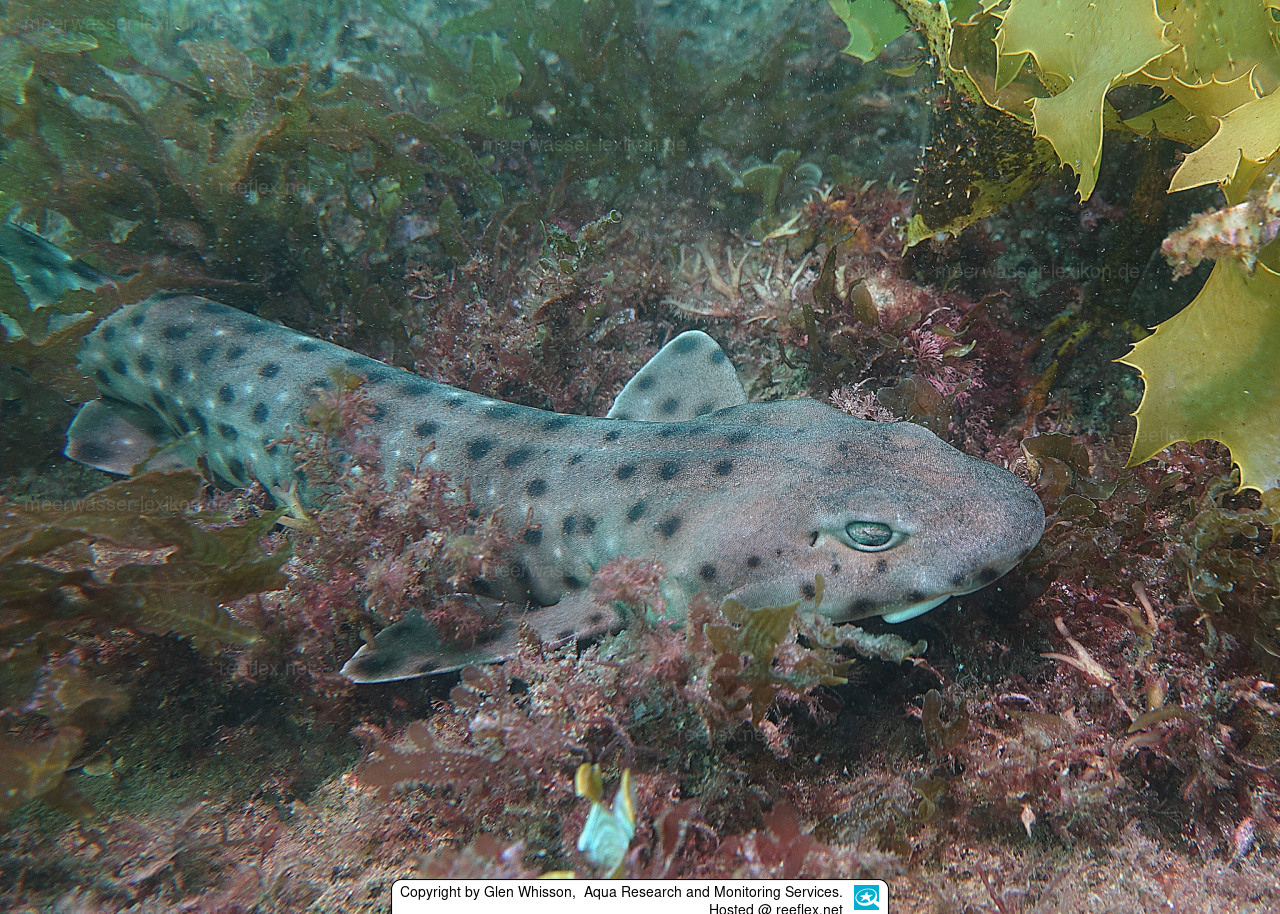
 Dr. Glen Whisson, Aqua Research and Monitoring Services, Australien

Info
Aulohalaelurus labiosus is a pale grey to yellowish brown catshark with many small to large black spots, some pale spots scattered over head and body,
The shark also has indistinct dark saddles on its back and fins with pale edges and submarginal black spots.
In general, this Australian endemic cat shark is nocturnal, lives in shallow coastal habitats and offshore reefs, and is well camouflaged from larger predators in many areas of the sea thanks to its patterning.
Male sharks usually remain smaller than females.
Synonyms:
Catulus labiosus Waite, 1905
Halaelurus labiosus (Waite, 1905)
Squalus maculatus Bloch & Schneider, 1801
Shark bites can be quite lethal to humans, especially the 10 most dangerous shark species are considered and can launch unprovoked attacks from humans: - Great white shark - Bull shark - Tiger shark - Sand tiger shark - Blacktip shark - Bronze shark - Spinner shark - Blue shark - Hammerhead shark - Whitetip shark The bite by a shark is one of the most basic fears of humans, but the number of deaths caused by shark attacks is very low: in 2015 there were 98 attacks by sharks and in 6 cases the attack resulted in a fatal end for humans. In 2016 there were 107 attacks by sharks and in 8 cases the attack resulted in a fatal end for humans. Sources: http://hai.ch/Hai-Infos/Unfaelle/index.html http://www.focus.de/reisen/videos/auch-urlaubsorte-betroffen-schrecklicher-rekord-2016-gab-es-mehr-hai-angriffe-als-je-zuvor_id_6519581.html http://www.spiegel.de/wissenschaft/natur/hai-angriffe-erreichen-2015-rekordhoch-weiterer-anstieg-erwartet-a-1076339.html http://www.zeit.de/2016/37/haie-toetung-tierschutz-surfer
In 2022, there were a total of 108 shark attacks in the USA.
Conversely, however, 100 million sharks were killed by humans. http://www.zeit.de/2016/37/haie-toetung-tierschutz-surfer The risk of being bitten by a shark varies greatly from region to region, with most attacks occurring in Florida, Australia and South Africa. Please be careful not to go into the water with bleeding skin wounds, heed bathing warnings from the authorities and be very careful when using surfboards, as sharks can easily confuse the boards with seals and harbour seals. After shark bites, always call a doctor or / and the rescue service as soon as possible, as heavy bleeding can be life-threatening.
https://worldanimalfoundation.org/advocate/shark-attack-statistics/
The shark also has indistinct dark saddles on its back and fins with pale edges and submarginal black spots.
In general, this Australian endemic cat shark is nocturnal, lives in shallow coastal habitats and offshore reefs, and is well camouflaged from larger predators in many areas of the sea thanks to its patterning.
Male sharks usually remain smaller than females.
Synonyms:
Catulus labiosus Waite, 1905
Halaelurus labiosus (Waite, 1905)
Squalus maculatus Bloch & Schneider, 1801
Shark bites can be quite lethal to humans, especially the 10 most dangerous shark species are considered and can launch unprovoked attacks from humans: - Great white shark - Bull shark - Tiger shark - Sand tiger shark - Blacktip shark - Bronze shark - Spinner shark - Blue shark - Hammerhead shark - Whitetip shark The bite by a shark is one of the most basic fears of humans, but the number of deaths caused by shark attacks is very low: in 2015 there were 98 attacks by sharks and in 6 cases the attack resulted in a fatal end for humans. In 2016 there were 107 attacks by sharks and in 8 cases the attack resulted in a fatal end for humans. Sources: http://hai.ch/Hai-Infos/Unfaelle/index.html http://www.focus.de/reisen/videos/auch-urlaubsorte-betroffen-schrecklicher-rekord-2016-gab-es-mehr-hai-angriffe-als-je-zuvor_id_6519581.html http://www.spiegel.de/wissenschaft/natur/hai-angriffe-erreichen-2015-rekordhoch-weiterer-anstieg-erwartet-a-1076339.html http://www.zeit.de/2016/37/haie-toetung-tierschutz-surfer
In 2022, there were a total of 108 shark attacks in the USA.
Conversely, however, 100 million sharks were killed by humans. http://www.zeit.de/2016/37/haie-toetung-tierschutz-surfer The risk of being bitten by a shark varies greatly from region to region, with most attacks occurring in Florida, Australia and South Africa. Please be careful not to go into the water with bleeding skin wounds, heed bathing warnings from the authorities and be very careful when using surfboards, as sharks can easily confuse the boards with seals and harbour seals. After shark bites, always call a doctor or / and the rescue service as soon as possible, as heavy bleeding can be life-threatening.
https://worldanimalfoundation.org/advocate/shark-attack-statistics/


