


 PhD Student Alfredo Rosales Ruiz, Spanien


Info
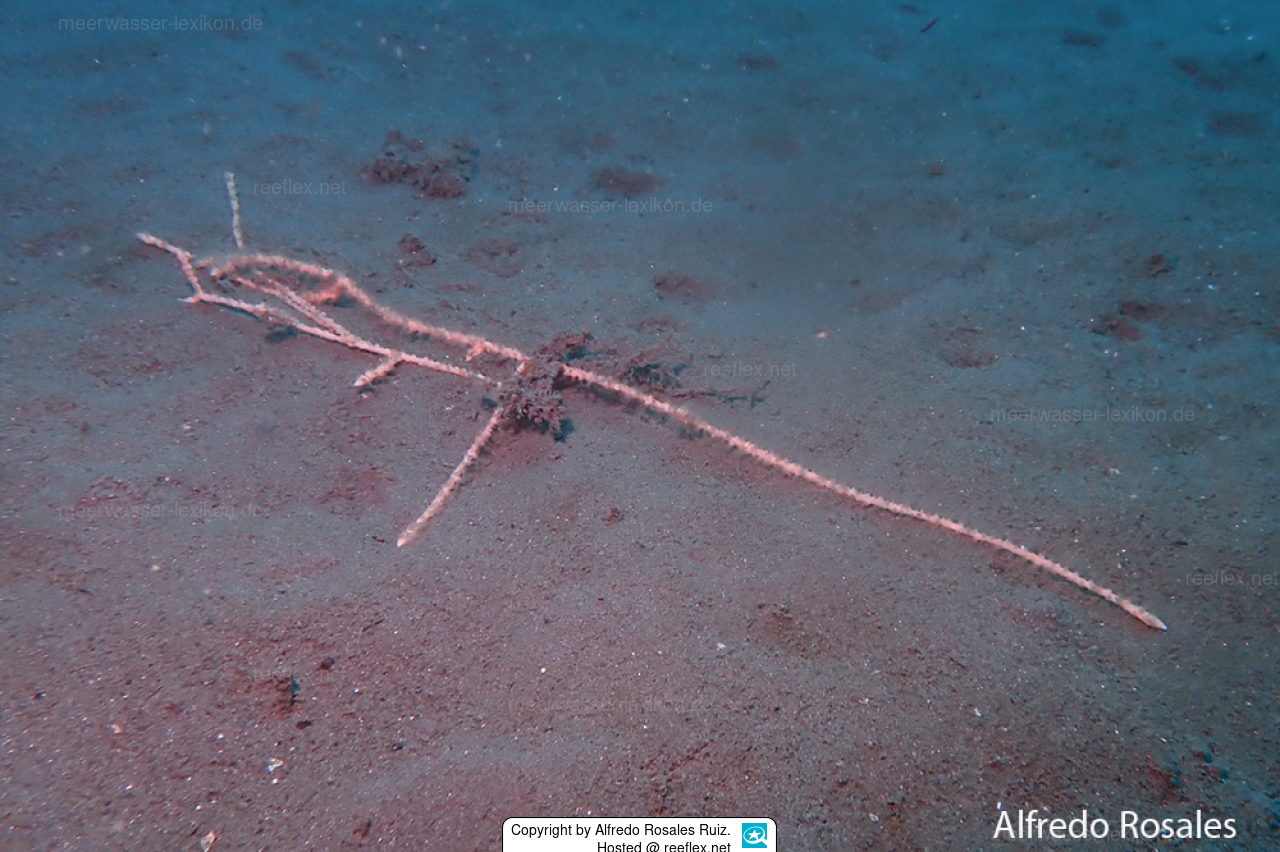
Eunicella filiformis forms thread-like colonies, sometimes branched and with a length of 50 cm - 73 cm.
The size specification of 73 cm comes from the first description of the species.
The colony is branched, planar, cable-like, thin, and flexible, hence the English name “Gorgonian cable.”
The slightly protruding calyxes of the polyps are striking.
This gorgonian develops freely on detrital sea floors and is therefore often landed by trawl fishermen.
Recommendation - the coral should be kept in a species-specific tank.
Feeding
The majority of gorgonians do not have zooxanthellae and do not live off light. Azooxanthellate gorgonians do not host symbiotic algae that produce nutrients and energy through photosynthesis.
The pumps should be switched off before feeding. In order for the gorgonian to survive in the aquarium, each individual polyp must be fed sufficiently, i.e. daily or 3-4 times a week. Without feeding, the gorgonian will not survive in the aquarium. The polyps need a certain amount of time to absorb the food (granules or dust food (Ultramarin, Cyclop Eeze) or frozen food (lobster eggs, mysis)). If shrimp and fish are present, they will try to steal the food, so it is essential to feed these cohabitants beforehand.
Newly introduced gorgonian sticks can be stimulated with a liquid food, e.g., PolypLab Polyp, to encourage the individual polyps to open. Only then can feeding be carried out.
The better the individual polyps take up the food provided, the better the growth and reproduction rates will be.
Azooxanthellate corals eat suspensions, marine snow, microplankton, and other organic matter, which is their natural food.
Colour: Eunicella filiformis has a whitish colour.
Eunicella filiformis is often parasitized by the furrow foot Anamenia gorgonophila (Kowalevsky, 1880), a worm mollusk.
This gastropod also parasitizes the gorgonian Paramuricea macrospina (Koch, 1882).
Our special thanks for the rare photos of the gorgonian go to the doctoral student (Doctor of Philosophy (Ph.D.), Alfredo Rosales Ruiz, from the University of Granada, Spain.
Synonyms:
Eunicea filiformis Studer, 1878 · unaccepted > superseded combination (original combination)
Eunicella filiformis Studer, 1901 · unaccepted (incorrect authority date)
The size specification of 73 cm comes from the first description of the species.
The colony is branched, planar, cable-like, thin, and flexible, hence the English name “Gorgonian cable.”
The slightly protruding calyxes of the polyps are striking.
This gorgonian develops freely on detrital sea floors and is therefore often landed by trawl fishermen.
Recommendation - the coral should be kept in a species-specific tank.
Feeding
The majority of gorgonians do not have zooxanthellae and do not live off light. Azooxanthellate gorgonians do not host symbiotic algae that produce nutrients and energy through photosynthesis.
The pumps should be switched off before feeding. In order for the gorgonian to survive in the aquarium, each individual polyp must be fed sufficiently, i.e. daily or 3-4 times a week. Without feeding, the gorgonian will not survive in the aquarium. The polyps need a certain amount of time to absorb the food (granules or dust food (Ultramarin, Cyclop Eeze) or frozen food (lobster eggs, mysis)). If shrimp and fish are present, they will try to steal the food, so it is essential to feed these cohabitants beforehand.
Newly introduced gorgonian sticks can be stimulated with a liquid food, e.g., PolypLab Polyp, to encourage the individual polyps to open. Only then can feeding be carried out.
The better the individual polyps take up the food provided, the better the growth and reproduction rates will be.
Azooxanthellate corals eat suspensions, marine snow, microplankton, and other organic matter, which is their natural food.
Colour: Eunicella filiformis has a whitish colour.
Eunicella filiformis is often parasitized by the furrow foot Anamenia gorgonophila (Kowalevsky, 1880), a worm mollusk.
This gastropod also parasitizes the gorgonian Paramuricea macrospina (Koch, 1882).
Our special thanks for the rare photos of the gorgonian go to the doctoral student (Doctor of Philosophy (Ph.D.), Alfredo Rosales Ruiz, from the University of Granada, Spain.
Synonyms:
Eunicea filiformis Studer, 1878 · unaccepted > superseded combination (original combination)
Eunicella filiformis Studer, 1901 · unaccepted (incorrect authority date)


