


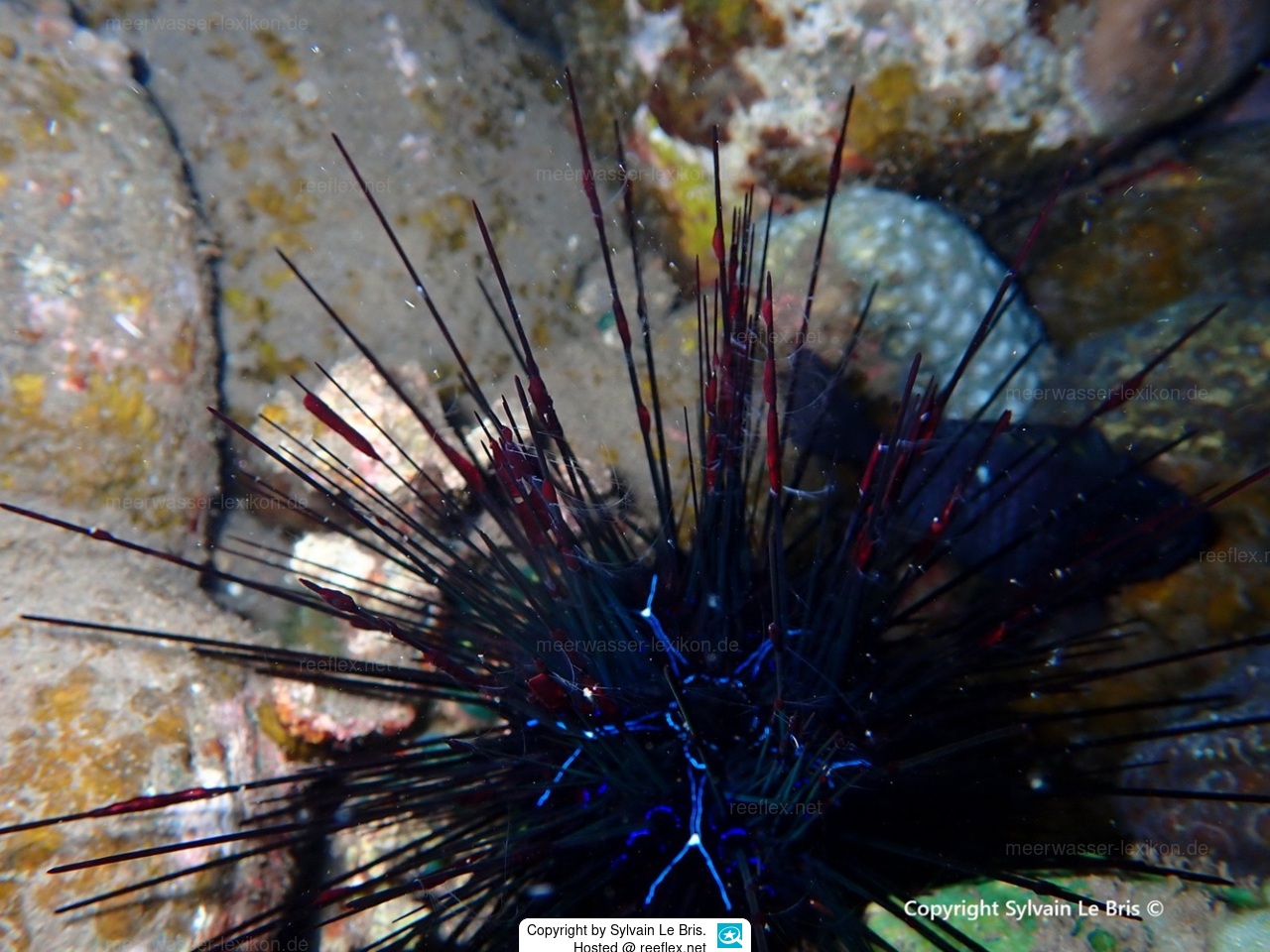
 Sylvain Le Bris, Frankreich


Info
Organisms of the order Platyctenida (Tentaculata) have a strongly flattened and modified benthic ctenophore, enabling them to crawl on a “foot” and making them look very similar to flatworms.
They often live epizootically as ectosymbionts on other organisms such as sponges or seaweed (Mills & Haddock 2007) .
Individuals of Coeloplana bannwarthii are dark, purple-colored organisms with a width of 0.5–4 cm and a length of 0.3–1 cm.
Coeloplana bannwarthii differs from both nudibranchs and flatworms in its thread-like, branched, retractable tentacles, which it uses to capture its prey.
It is an active hunter that catches its prey with its tentacles.
As reported by ResearchGate, Coeloplana bannwarthii is also known as a symbiotic species that often lives in association with other marine animals such as corals and sea anemones.
Coeloplana bannwarthii lives exclusively on the primary spines of the aboral side of sea urchins, from where they can move anywhere.
Their ventral side is aligned with the spine so that their sagittal plane is perpendicular to the longitudinal axis of the spine.
The creeping reef jellyfish adapts perfectly to the substrate on which it lies and is difficult to spot on its hosts due to its color.
The only way to locate it is to spot its tentacle apparatus floating in the water column.
When fully extended, the tentacles are three times the width of the specimen and reach approximately 12 cm in the largest individuals.
The retraction of the tentacle apparatus is a rapid, active phenomenon that takes only a few seconds and only occurs when the specimens are disturbed (e.g.,
when touched with tweezers).
Coeloplana bannwarthii has been detected on the following sea urchins:
Astropyga radiata (Leske, 1778)
Diadema paucispinum A. Agassiz, 1863
Diadema setosum (Leske, 1778
Echinothrix diadema (Linnaeus, 1758)
Vallicula multiformis Rankin, 1956
In a study of 280 specimens of the starfish Diadema setosum, 27 individuals were infested (infestation frequency: 9.6%).
Of the 280 collected on the four occasions,
the number of ctenophores per infested host varied between 2 and 50 comb jellies, with the infestation rate of sea urchins exceeding 100 individuals per sea urchin.
The water depths of the creeping comb jelly are not documented, but the depth and temperature of the water can be an indication of the depth at which the hosts of the comb jelly occur. Based on Diadema setosum, we have initially adopted its data of 0–70 meters.
Ecology and behavior:
During the day, the ctenophores concentrate near the sea urchin's shell and are difficult to spot.
At night, they crawl into the upper parts of the spines and extend their tentacles to feed.
Synonym: Coeloplana bannwarthi Krumbach, 1933
They often live epizootically as ectosymbionts on other organisms such as sponges or seaweed (Mills & Haddock 2007) .
Individuals of Coeloplana bannwarthii are dark, purple-colored organisms with a width of 0.5–4 cm and a length of 0.3–1 cm.
Coeloplana bannwarthii differs from both nudibranchs and flatworms in its thread-like, branched, retractable tentacles, which it uses to capture its prey.
It is an active hunter that catches its prey with its tentacles.
As reported by ResearchGate, Coeloplana bannwarthii is also known as a symbiotic species that often lives in association with other marine animals such as corals and sea anemones.
Coeloplana bannwarthii lives exclusively on the primary spines of the aboral side of sea urchins, from where they can move anywhere.
Their ventral side is aligned with the spine so that their sagittal plane is perpendicular to the longitudinal axis of the spine.
The creeping reef jellyfish adapts perfectly to the substrate on which it lies and is difficult to spot on its hosts due to its color.
The only way to locate it is to spot its tentacle apparatus floating in the water column.
When fully extended, the tentacles are three times the width of the specimen and reach approximately 12 cm in the largest individuals.
The retraction of the tentacle apparatus is a rapid, active phenomenon that takes only a few seconds and only occurs when the specimens are disturbed (e.g.,
when touched with tweezers).
Coeloplana bannwarthii has been detected on the following sea urchins:
Astropyga radiata (Leske, 1778)
Diadema paucispinum A. Agassiz, 1863
Diadema setosum (Leske, 1778
Echinothrix diadema (Linnaeus, 1758)
Vallicula multiformis Rankin, 1956
In a study of 280 specimens of the starfish Diadema setosum, 27 individuals were infested (infestation frequency: 9.6%).
Of the 280 collected on the four occasions,
the number of ctenophores per infested host varied between 2 and 50 comb jellies, with the infestation rate of sea urchins exceeding 100 individuals per sea urchin.
The water depths of the creeping comb jelly are not documented, but the depth and temperature of the water can be an indication of the depth at which the hosts of the comb jelly occur. Based on Diadema setosum, we have initially adopted its data of 0–70 meters.
Ecology and behavior:
During the day, the ctenophores concentrate near the sea urchin's shell and are difficult to spot.
At night, they crawl into the upper parts of the spines and extend their tentacles to feed.
Synonym: Coeloplana bannwarthi Krumbach, 1933

