


 ZooKeys


Info
The Bermuda fireworm, a bristle worm, is a unique annelid due to its distinctive mating behavior and physiology.
In preparation for reproduction, Bermuda fireworms of both sexes undergo morphological changes, including enlargement and pigmentation of their four eyes to improve visual acuity.
This is particularly pronounced in males in order to perceive the bioluminescence of females.
This creates the conditions for a highly synchronized mating swarm, in which selection pressure from predators favors precise timing to minimize the vulnerability of isolated or early individuals.
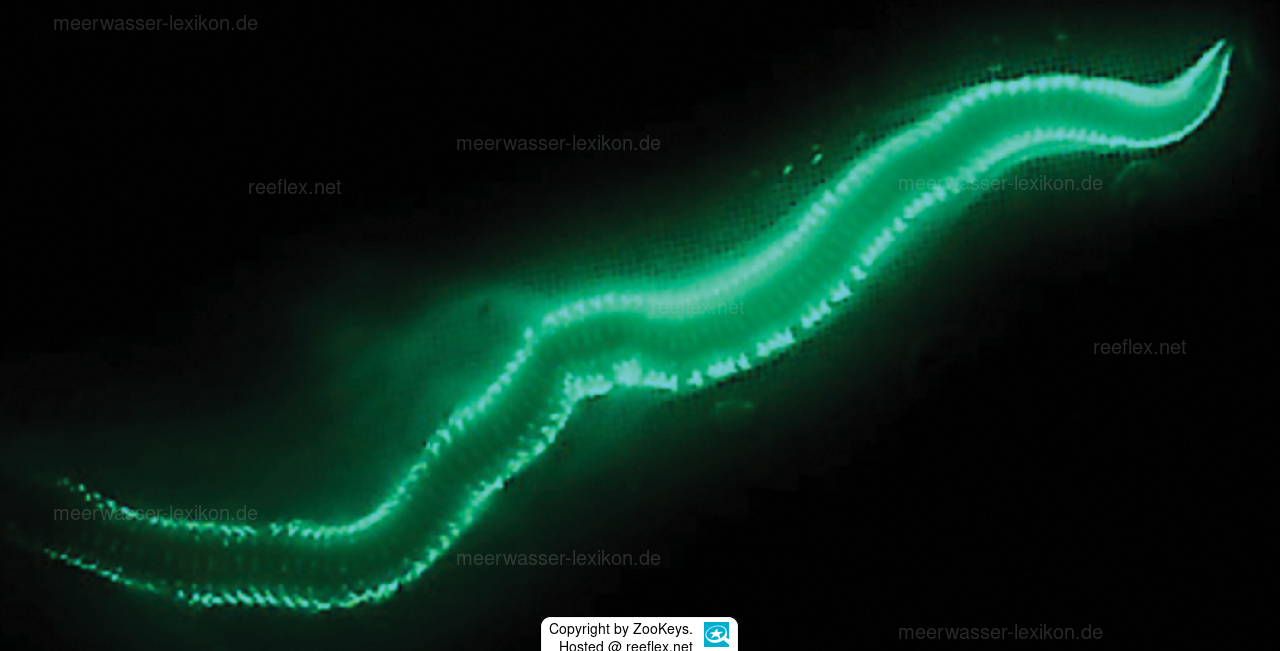
The females initiate the ritual by rising to the surface and swimming in slow circles while emitting a continuous blue-green glow from secreted luminous mucus and releasing their gametes.
Triggered by this display, males swim toward the glowing females, producing rapid, successive flashes of bioluminescence while releasing their own gametes into the surrounding water.
The bioluminescence peaks in the green region of the visible spectrum, with wavelengths between 504 and 507 nm.
Their visual system is most sensitive to the above wavelength, as shown by electroretinogram (ERG) recordings in response to light at multiple wavelengths (). The similarities between the detected and emitted light suggest that Bermuda fireworms are visually tuned to recognize mating signals from bioluminescence.
Here is another beautiful description of mating
Exactly fifty-five minutes after the sun disappeared below the horizon, the first “fireworks” lit up the water: greenish clouds of glowing dust spinning in circles. These were the females, leaving their tiny tubes on the seabed and laying their eggs in a graceful, dance-like movement.
Moments later, the males appeared. With their complex eyes, they caught the glow of the females and shot toward them, leaving a sparkling trail behind them.
Exactly fifty-five minutes after the sun disappeared below the horizon, the first “fireworks” lit up the water: greenish clouds of glowing dust spinning in circles. These were the females, leaving their tiny tubes on the seabed and laying their eggs in a graceful, dance-like movement.
Odontosyllis enopla is common in shallow bays around Bermuda (Sterrer 1986). They live in sheltered, rocky waters and swim to the surface to spawn 2 to 3 days after each full moon (Sterrer 1986).
Their spawning activity peaks during the summer months (Huntsman 1948). Huntsman (1948) noted that after being caught, Odontosyllis enopla swims to the bottom of the container and forms a webbed tube around itself, with its head protruding from one end.
This is an indication that Odontosyllis enopla lives in a tube-like structure on the bottom of the bays outside of the mating season.
It has been observed that male worms are also attracted to the beam of a flashlight on the surface, while female worms do not respond to this light.
After spawning, the worms shed their bristles and sink back to the bottom to begin their ritual again after another new moon.
The only observed predator of Odontosyllis enopla is the spiny dogfish Atherinomorus stipes, which feeds on the annelids during the mating season (Gatson and Hall 2000).
However, when collected, the fish had regurgitated and were paralyzed, leading to the conclusion that the bioluminescent substance, if not the worms themselves, is toxic (Gatson and Hall 2000).
Extraordinary little creatures—insignificant in the vastness of the Atlantic, yet impressive with their luminous dance of life.
Literature reference:
Wyant LD, Cruz BA, Gonzalez AD, Kovalcik JM, Carolus MA, Hutto LC, Chutjian H, Roman JC, Cappelmann A, Ankney JJ, Popp A, Wood JB, Pettay DT, Brugler MR (2026) Partial mitochondrial genome of the enigmatic Bermuda fireworm Odontosyllis enopla Verrill, 1900 (Annelida, Syllidae, Eusyllinae) and its phylogenetic implications.
ZooKeys 1270: 33-49. https://doi.org/10.3897/zookeys.1270.177446Reference:
Wyant LD, Cruz BA, Gonzalez AD, Kovalcik JM, Carolus MA, Hutto LC, Chutjian H, Roman JC, Cappelmann A, Ankney JJ, Popp A, Wood JB, Pettay DT, Brugler MR (2026) Partial mitochondrial genome of the enigmatic Bermuda fireworm Odontosyllis enopla Verrill, 1900 (Annelida, Syllidae, Eusyllinae) and its phylogenetic implications. ZooKeys 1270: 33-49. https://doi.org/10.3897/zookeys.1270.177446
This is an open access article distributed under the terms of the Creative Commons Attribution License (CC BY 4.0), which permits unrestricted use, distribution, and reproduction in any medium, provided the original author and source are credited.
In preparation for reproduction, Bermuda fireworms of both sexes undergo morphological changes, including enlargement and pigmentation of their four eyes to improve visual acuity.
This is particularly pronounced in males in order to perceive the bioluminescence of females.
This creates the conditions for a highly synchronized mating swarm, in which selection pressure from predators favors precise timing to minimize the vulnerability of isolated or early individuals.
The females initiate the ritual by rising to the surface and swimming in slow circles while emitting a continuous blue-green glow from secreted luminous mucus and releasing their gametes.
Triggered by this display, males swim toward the glowing females, producing rapid, successive flashes of bioluminescence while releasing their own gametes into the surrounding water.
The bioluminescence peaks in the green region of the visible spectrum, with wavelengths between 504 and 507 nm.
Their visual system is most sensitive to the above wavelength, as shown by electroretinogram (ERG) recordings in response to light at multiple wavelengths (). The similarities between the detected and emitted light suggest that Bermuda fireworms are visually tuned to recognize mating signals from bioluminescence.
Here is another beautiful description of mating
Exactly fifty-five minutes after the sun disappeared below the horizon, the first “fireworks” lit up the water: greenish clouds of glowing dust spinning in circles. These were the females, leaving their tiny tubes on the seabed and laying their eggs in a graceful, dance-like movement.
Moments later, the males appeared. With their complex eyes, they caught the glow of the females and shot toward them, leaving a sparkling trail behind them.
Exactly fifty-five minutes after the sun disappeared below the horizon, the first “fireworks” lit up the water: greenish clouds of glowing dust spinning in circles. These were the females, leaving their tiny tubes on the seabed and laying their eggs in a graceful, dance-like movement.
Odontosyllis enopla is common in shallow bays around Bermuda (Sterrer 1986). They live in sheltered, rocky waters and swim to the surface to spawn 2 to 3 days after each full moon (Sterrer 1986).
Their spawning activity peaks during the summer months (Huntsman 1948). Huntsman (1948) noted that after being caught, Odontosyllis enopla swims to the bottom of the container and forms a webbed tube around itself, with its head protruding from one end.
This is an indication that Odontosyllis enopla lives in a tube-like structure on the bottom of the bays outside of the mating season.
It has been observed that male worms are also attracted to the beam of a flashlight on the surface, while female worms do not respond to this light.
After spawning, the worms shed their bristles and sink back to the bottom to begin their ritual again after another new moon.
The only observed predator of Odontosyllis enopla is the spiny dogfish Atherinomorus stipes, which feeds on the annelids during the mating season (Gatson and Hall 2000).
However, when collected, the fish had regurgitated and were paralyzed, leading to the conclusion that the bioluminescent substance, if not the worms themselves, is toxic (Gatson and Hall 2000).
Extraordinary little creatures—insignificant in the vastness of the Atlantic, yet impressive with their luminous dance of life.
Literature reference:
Wyant LD, Cruz BA, Gonzalez AD, Kovalcik JM, Carolus MA, Hutto LC, Chutjian H, Roman JC, Cappelmann A, Ankney JJ, Popp A, Wood JB, Pettay DT, Brugler MR (2026) Partial mitochondrial genome of the enigmatic Bermuda fireworm Odontosyllis enopla Verrill, 1900 (Annelida, Syllidae, Eusyllinae) and its phylogenetic implications.
ZooKeys 1270: 33-49. https://doi.org/10.3897/zookeys.1270.177446Reference:
Wyant LD, Cruz BA, Gonzalez AD, Kovalcik JM, Carolus MA, Hutto LC, Chutjian H, Roman JC, Cappelmann A, Ankney JJ, Popp A, Wood JB, Pettay DT, Brugler MR (2026) Partial mitochondrial genome of the enigmatic Bermuda fireworm Odontosyllis enopla Verrill, 1900 (Annelida, Syllidae, Eusyllinae) and its phylogenetic implications. ZooKeys 1270: 33-49. https://doi.org/10.3897/zookeys.1270.177446
This is an open access article distributed under the terms of the Creative Commons Attribution License (CC BY 4.0), which permits unrestricted use, distribution, and reproduction in any medium, provided the original author and source are credited.

