


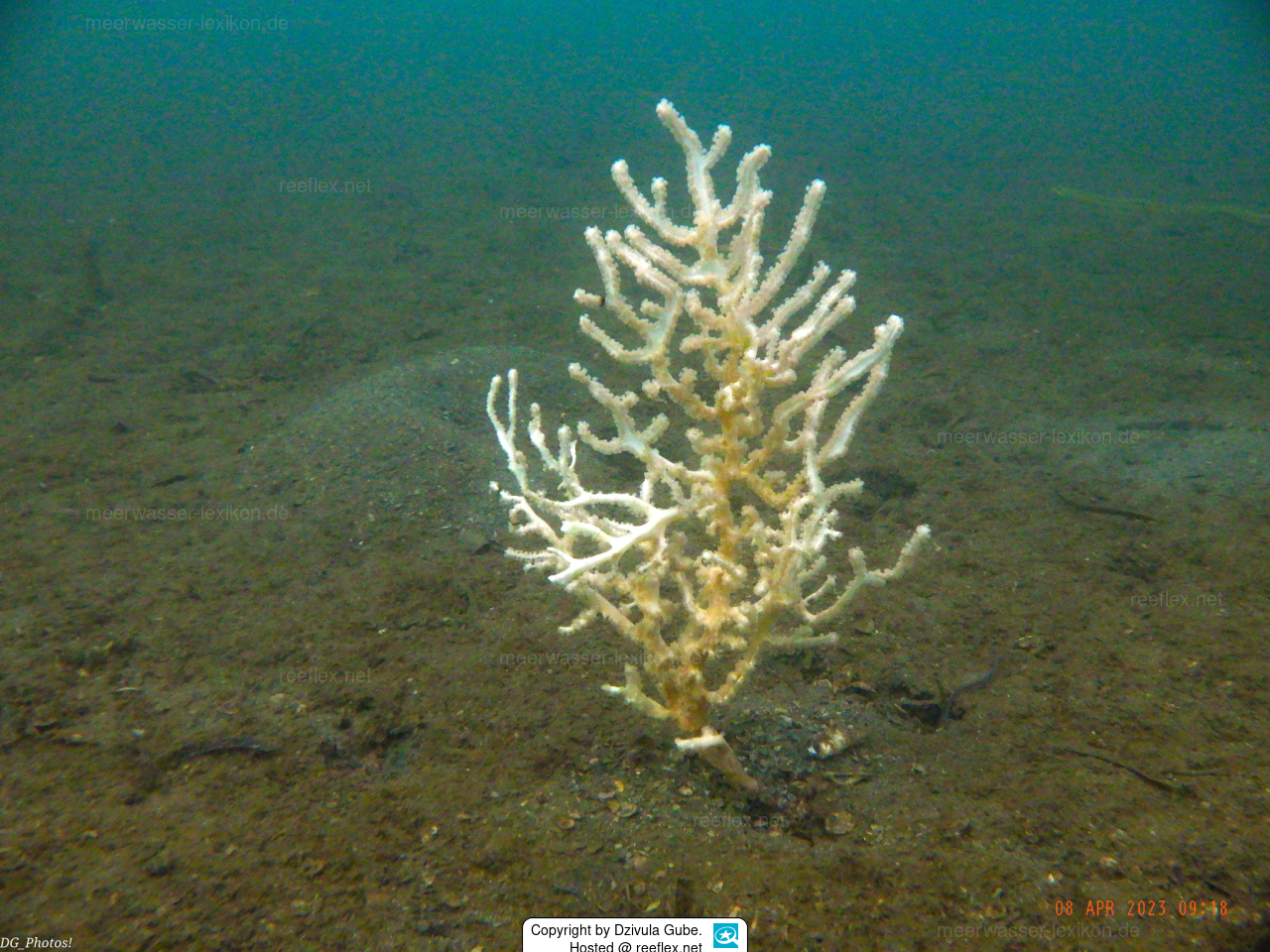
 Dzivula Gube, Kenia


Info
Solenocaulon tortuosum is a species widely distributed in the Indian Ocean, whose range ends in the western Pacific Ocean around Indonesia and Australia.
Despite its wide distribution, information on water depth and water temperatures is very scarce.
The gorgonian grows on different substrates and forms bush-like colonies that develop from a single stem
The description of the species from Australia indicates a slender, almost horizontal orientation of the colony, while Grasshoff in “Reef Gorgonians of New Caledonia” speaks of a slender, upright, peculiar-looking shape.
The main stem is tubular throughout and the short, slender branches are curved, irregularly shaped and arranged.
The branches break easily, so divers should be careful when observing them so as not to damage the coral.
The entire colony has a rugged and ragged appearance.
Neither the original description nor that of Dr. Grashoff from New Caledonia records the color of the kalonia. Dr. Monika Bryce describes the colony in her “Octocoral Field Guide: Kimberley, Western Australia” as reddish and significantly smaller, at only 20 cm.
The ghost goby Pleurosicya annandalei lives as a commensal on Solenocaulon tortuosum.
Our special thanks go to Dzivula Gube from Kenya, who was able to photograph the gorgonian near Lunga-Lunga in the western Indian Ocean.
Synonym:
Solenocaulon (Malacosolenocaulon) tortuosum Gray, 1862 · alternative representation
Despite its wide distribution, information on water depth and water temperatures is very scarce.
The gorgonian grows on different substrates and forms bush-like colonies that develop from a single stem
The description of the species from Australia indicates a slender, almost horizontal orientation of the colony, while Grasshoff in “Reef Gorgonians of New Caledonia” speaks of a slender, upright, peculiar-looking shape.
The main stem is tubular throughout and the short, slender branches are curved, irregularly shaped and arranged.
The branches break easily, so divers should be careful when observing them so as not to damage the coral.
The entire colony has a rugged and ragged appearance.
Neither the original description nor that of Dr. Grashoff from New Caledonia records the color of the kalonia. Dr. Monika Bryce describes the colony in her “Octocoral Field Guide: Kimberley, Western Australia” as reddish and significantly smaller, at only 20 cm.
The ghost goby Pleurosicya annandalei lives as a commensal on Solenocaulon tortuosum.
Our special thanks go to Dzivula Gube from Kenya, who was able to photograph the gorgonian near Lunga-Lunga in the western Indian Ocean.
Synonym:
Solenocaulon (Malacosolenocaulon) tortuosum Gray, 1862 · alternative representation

