


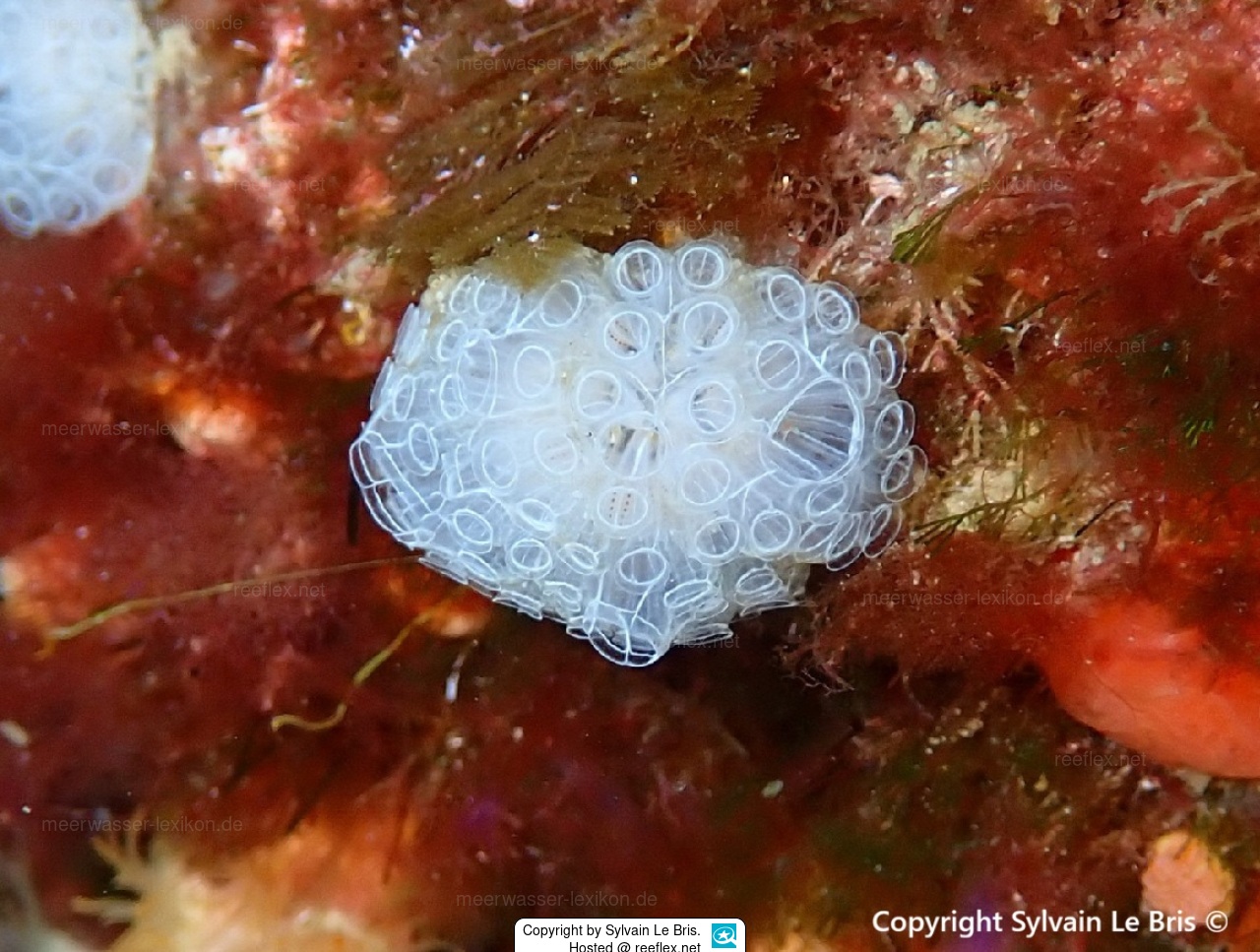
 Sylvain Le Bris, Frankreich


Info
Botrylloides crystallinus A. Bay-Nouailhat, W. Bay-Nouailhat, Gasparini & Brunetti, 2020
Botrylloides crystallinus is a colonial ascidian that is found primarily in reef zones with lower light levels but better water flow, such as rocky areas and overhangs, and can be encountered in the Mediterranean from France to Italy.
In such habitats, plankton and other organic suspended matter are regularly and continuously washed into the colony.
The sea squirt typically reaches a diameter of up to 3 cm and a thickness of 7–8 cm.
The colony is predominantly spherical to massive and may have several rounded lobes.
The tunic is always very thick and can reach a height several times that of the filtering zooids.
It is traversed by a network of very thin colonial blood vessels connecting the zooids and buds.
The tunic is soft, sticky, and crystalline, transparent and white to translucent pale yellow.
Thin white lines highlight the tunic from the base of the mouth siphon to the edge of the dorsal lip and the atrium opening, tracing a thin, branched line pattern on the colony’s surface that runs through the zooids to the edge of the common cloacal opening.
White longitudinal lines are also present in the gill sac: two large ones highlighting the endostyle and the dorsal lamella, as well as six thin ones emphasizing the internal longitudinal vessels. White pigment present
The individual zooids are quite short, measuring approximately 3–4 mm in length; however, the number and size of the zooids vary greatly within the same colony
Ecology and water temperature:
All samples were collected on May 9, 2018 (water temperature 16 °C); many of them were in full activity with filtering zooids, while others exhibited some zooids in the regression stage.
In the spring, as the temperature rose to summer levels, the number of regressing zooids increased, with the regression spreading from the base of the colony to its apex until all zooids had regressed
Regression also affects the buds, and the colony reduces to a cluster of tiny round bodies; in the following July (average water temperature 21 °C), almost all colonies appear as gelatinous masses with only tiny whitish ampullae on their surface
During dives on August 10 and 17, following a period of high temperatures reaching up to 28 °C, no colonies could be detected.
Although these observations do not cover the entire seasonal period, they suggest that the species exhibits a seasonal cycle, with a preference for the lower temperatures of winter.
In summer, when the water temperature remains consistently above 20 °C, high mortality likely occurs, which would explain the apparent absence of the species.
Botrylloides crystallinus lives firmly anchored to the substrate and is connected to it by a narrow base.
Sometimes debris accumulates on its surface.
The zoids are arranged in rows around large shared cloacal siphons. The mouth siphon of each zoid is marked by a white rim,
As a seasonal species found mainly in winter and spring, the colonies end their life cycle as a spherical, cartilaginous mass, interspersed with atrophied zoids that form “zipper” patterns on its surface.
The colonies live in shaded areas, attached to vertical rock walls or overhangs at depths ranging from 4 to more than 30 meters.
Botrylloides crystallinus is a colonial ascidian that is found primarily in reef zones with lower light levels but better water flow, such as rocky areas and overhangs, and can be encountered in the Mediterranean from France to Italy.
In such habitats, plankton and other organic suspended matter are regularly and continuously washed into the colony.
The sea squirt typically reaches a diameter of up to 3 cm and a thickness of 7–8 cm.
The colony is predominantly spherical to massive and may have several rounded lobes.
The tunic is always very thick and can reach a height several times that of the filtering zooids.
It is traversed by a network of very thin colonial blood vessels connecting the zooids and buds.
The tunic is soft, sticky, and crystalline, transparent and white to translucent pale yellow.
Thin white lines highlight the tunic from the base of the mouth siphon to the edge of the dorsal lip and the atrium opening, tracing a thin, branched line pattern on the colony’s surface that runs through the zooids to the edge of the common cloacal opening.
White longitudinal lines are also present in the gill sac: two large ones highlighting the endostyle and the dorsal lamella, as well as six thin ones emphasizing the internal longitudinal vessels. White pigment present
The individual zooids are quite short, measuring approximately 3–4 mm in length; however, the number and size of the zooids vary greatly within the same colony
Ecology and water temperature:
All samples were collected on May 9, 2018 (water temperature 16 °C); many of them were in full activity with filtering zooids, while others exhibited some zooids in the regression stage.
In the spring, as the temperature rose to summer levels, the number of regressing zooids increased, with the regression spreading from the base of the colony to its apex until all zooids had regressed
Regression also affects the buds, and the colony reduces to a cluster of tiny round bodies; in the following July (average water temperature 21 °C), almost all colonies appear as gelatinous masses with only tiny whitish ampullae on their surface
During dives on August 10 and 17, following a period of high temperatures reaching up to 28 °C, no colonies could be detected.
Although these observations do not cover the entire seasonal period, they suggest that the species exhibits a seasonal cycle, with a preference for the lower temperatures of winter.
In summer, when the water temperature remains consistently above 20 °C, high mortality likely occurs, which would explain the apparent absence of the species.
Botrylloides crystallinus lives firmly anchored to the substrate and is connected to it by a narrow base.
Sometimes debris accumulates on its surface.
The zoids are arranged in rows around large shared cloacal siphons. The mouth siphon of each zoid is marked by a white rim,
As a seasonal species found mainly in winter and spring, the colonies end their life cycle as a spherical, cartilaginous mass, interspersed with atrophied zoids that form “zipper” patterns on its surface.
The colonies live in shaded areas, attached to vertical rock walls or overhangs at depths ranging from 4 to more than 30 meters.


