

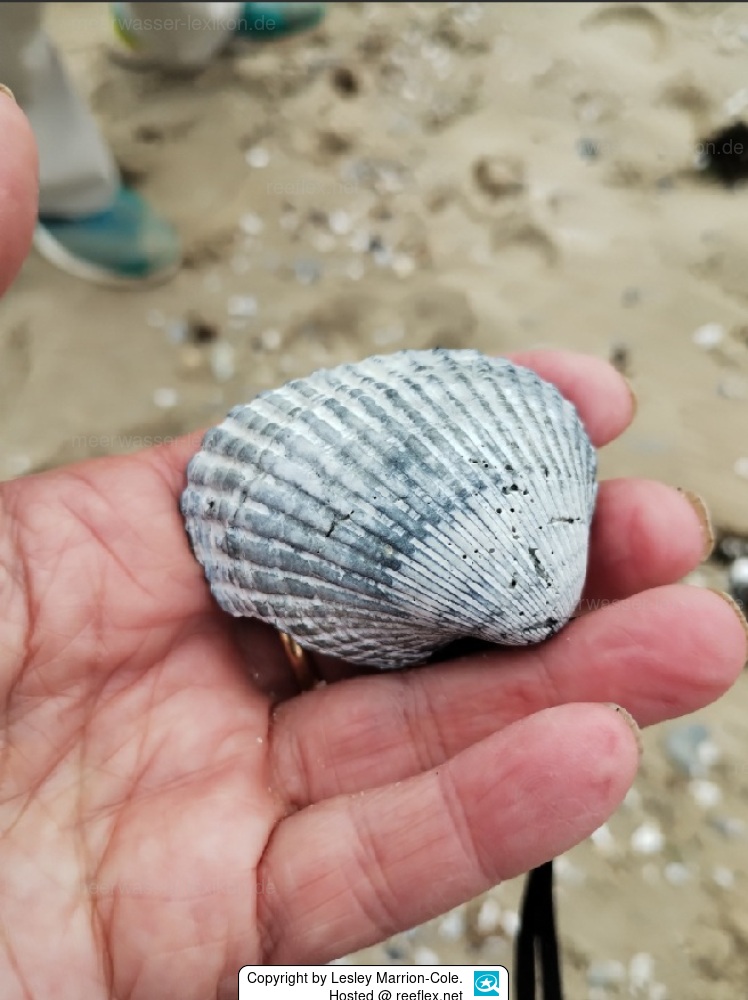
 Lesley Marrion-Cole, Vereinigtes Königreich

Info
Anadara trapezia is abundant in its range and lives buried shallowly in sand or mud “seagrass” (Zostera) beds in estuaries and enclosed bays, where the salinity is slightly lower than that of the ocean; it is a eurythermic species.
The shell is white-brown or white, with ribs extending from the hinge.
The white shells are heavy, obliquely ovoid, and have a thick outer layer (periostracum), particularly at the posterior end.
The external sculpture consists of broad, strong, radially running ribs.
Adult specimens generally lack a filamentous byssus; the shell reaches a diameter of up to 8 cm.
Description:
The Sydney cockle is massive, heavy, monovalve, asymmetrical, and has an elongated shape.
Umboni in front of the midline, raised, widely spaced. Hinge line straight.
The posterior end is elongated and broadly rounded; the anterior end is also broadly rounded.
The ventral margin is smoothly rounded; a byssus notch is absent.
The hinge is equipped with 40–50 teeth.
The ligament is external.
The inner margin is coarsely notched; muscle scars are clearly defined, nearly circular, and white.
The outer surface shows strong radial ribs, often interspersed with coarse growth interruptions.
The periostracum is thick and dark brown.
The shell color is white, concealed by the periostracum during the animal’s lifetime.
The mussel is found primarily in sheltered intertidal zones and shallow mudflats, in sand and seagrass beds.
Mud Arks burrow into the mud. This species belongs to a group of clams found primarily in the tropical waters of northern Australia. They are sometimes caught by humans for food, but contain very little meat. Empty shells are frequently found in Aboriginal shell middens.
The shell is white-brown or white, with ribs extending from the hinge.
The white shells are heavy, obliquely ovoid, and have a thick outer layer (periostracum), particularly at the posterior end.
The external sculpture consists of broad, strong, radially running ribs.
Adult specimens generally lack a filamentous byssus; the shell reaches a diameter of up to 8 cm.
Description:
The Sydney cockle is massive, heavy, monovalve, asymmetrical, and has an elongated shape.
Umboni in front of the midline, raised, widely spaced. Hinge line straight.
The posterior end is elongated and broadly rounded; the anterior end is also broadly rounded.
The ventral margin is smoothly rounded; a byssus notch is absent.
The hinge is equipped with 40–50 teeth.
The ligament is external.
The inner margin is coarsely notched; muscle scars are clearly defined, nearly circular, and white.
The outer surface shows strong radial ribs, often interspersed with coarse growth interruptions.
The periostracum is thick and dark brown.
The shell color is white, concealed by the periostracum during the animal’s lifetime.
The mussel is found primarily in sheltered intertidal zones and shallow mudflats, in sand and seagrass beds.
Mud Arks burrow into the mud. This species belongs to a group of clams found primarily in the tropical waters of northern Australia. They are sometimes caught by humans for food, but contain very little meat. Empty shells are frequently found in Aboriginal shell middens.

