


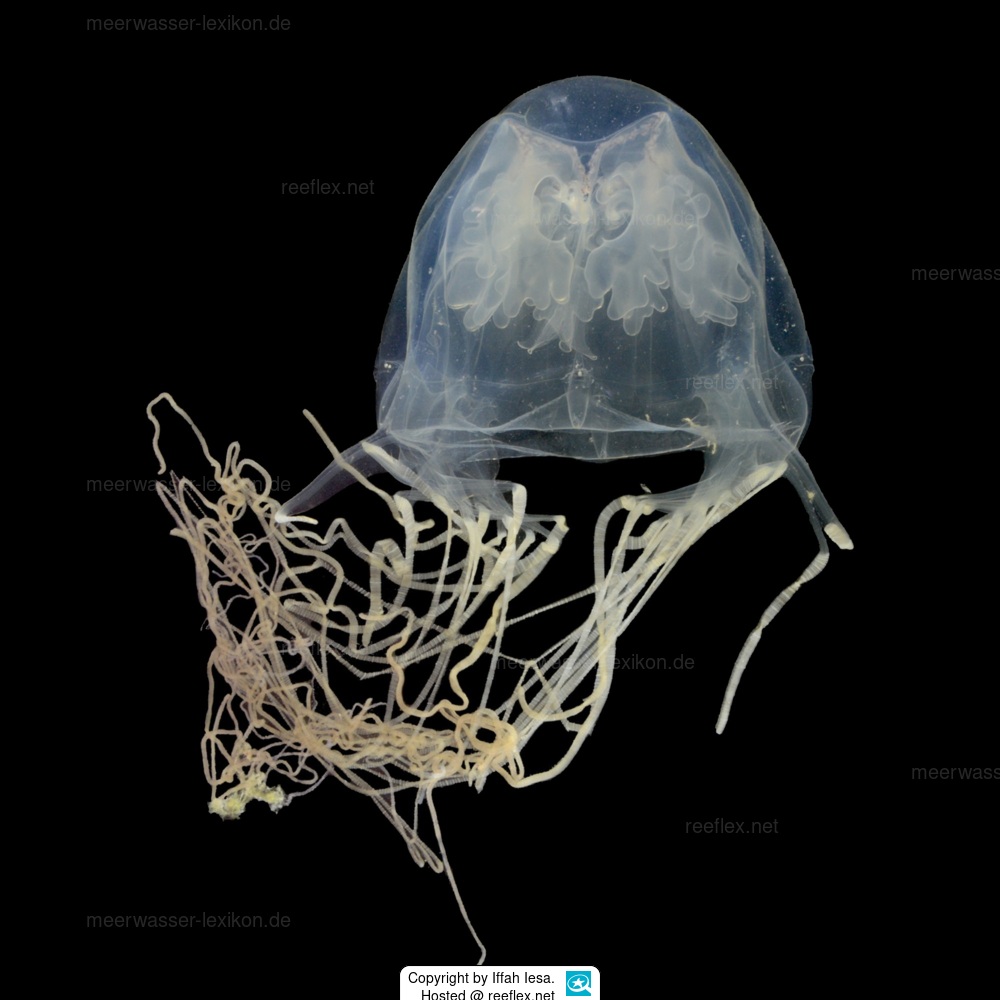
 Dr. Iffah Iesa, Singapur


Info
They are very small, barely visible, and extremely poisonous—Chironex box jellyfish—yet these tiny jellyfish pose a major danger to humans.
Lifeguards along Australia’s coast take extra precautions against these venomous creatures and potential stings by wearing sheer tights over their heads, chests, arms, and legs.
The box jellyfish’s stinging cells cannot penetrate this fine fabric. Better safe than sorry!
An interesting comparison:
The super-predator of the oceans—alongside orcas, the great white shark—is responsible for about 10 fatal accidents involving humans worldwide each year, and local people are in an uproar and fear; beaches are equipped with shark warning signs, and locals and tourists avoid these beaches.
The small Chironex box jellyfish are responsible for about 100 deaths per year—ten times as many—yet one reads far less about them in the press.
What is clear, however, is that the more people develop a better understanding of the biodiversity and seasonality of venomous box jellyfish, the more this will help mitigate the risk that box jellyfish pose to human health and safety during maritime activities such as swimming, snorkeling, diving, and other water sports.
The first description of the new box jellyfish species Chironex blakangmati was published on May 15, 2026; it was collected near Sentosa Island, Palawan Beach, in the Singapore Strait after jellyfish strandings were reported by Sentosa Beach Patrol staff, members of the public, or staff of the National Parks Board Singapore (NParks).
Chironex blakangmati is a multi-armed box jellyfish, just like its sister species
Chironex indrasaksajiae Sucharitakul, 2017
Chironex yamaguchii Lewis & Bentlage, 2009
Chironex fleckeri Southcott, 1956
Chironex blakangmati possesses a conical to cuboid bell and seven tentacles per pedalium.
The bell is transparent, yellowish with slightly opaque internal structures, with the cockscomb-like gastric pouches visible through the bell; it reaches a diameter of just under 10 cm.
The tentacles are transparent to khaki-colored, with darker shades depending on the degree of contraction; their total length could not be determined because the collected specimens were damaged to varying degrees and the tentacles were severed, but exact measurements will certainly be provided in the future.
It is therefore more than understandable that this box jellyfish is barely visible in the water to swimmers.
Etymology. The name of this species is derived from Bahasa Melayu, an Austronesian language spoken in the region and the national language of Singapore, and refers to Sentosa Island, where the animal was collected. The island of Sentosa was formerly known as “Pulau Blakang Mati,” which means “Island of Death Behind”; therefore, “blakangmati” is a noun in apposition used to designate the geographical location.
We would like to extend our special thanks to Dr. Iffah Iesa, who provided us with a wonderful photo of the box jellyfish.
Lifeguards along Australia’s coast take extra precautions against these venomous creatures and potential stings by wearing sheer tights over their heads, chests, arms, and legs.
The box jellyfish’s stinging cells cannot penetrate this fine fabric. Better safe than sorry!
An interesting comparison:
The super-predator of the oceans—alongside orcas, the great white shark—is responsible for about 10 fatal accidents involving humans worldwide each year, and local people are in an uproar and fear; beaches are equipped with shark warning signs, and locals and tourists avoid these beaches.
The small Chironex box jellyfish are responsible for about 100 deaths per year—ten times as many—yet one reads far less about them in the press.
What is clear, however, is that the more people develop a better understanding of the biodiversity and seasonality of venomous box jellyfish, the more this will help mitigate the risk that box jellyfish pose to human health and safety during maritime activities such as swimming, snorkeling, diving, and other water sports.
The first description of the new box jellyfish species Chironex blakangmati was published on May 15, 2026; it was collected near Sentosa Island, Palawan Beach, in the Singapore Strait after jellyfish strandings were reported by Sentosa Beach Patrol staff, members of the public, or staff of the National Parks Board Singapore (NParks).
Chironex blakangmati is a multi-armed box jellyfish, just like its sister species
Chironex indrasaksajiae Sucharitakul, 2017
Chironex yamaguchii Lewis & Bentlage, 2009
Chironex fleckeri Southcott, 1956
Chironex blakangmati possesses a conical to cuboid bell and seven tentacles per pedalium.
The bell is transparent, yellowish with slightly opaque internal structures, with the cockscomb-like gastric pouches visible through the bell; it reaches a diameter of just under 10 cm.
The tentacles are transparent to khaki-colored, with darker shades depending on the degree of contraction; their total length could not be determined because the collected specimens were damaged to varying degrees and the tentacles were severed, but exact measurements will certainly be provided in the future.
It is therefore more than understandable that this box jellyfish is barely visible in the water to swimmers.
Etymology. The name of this species is derived from Bahasa Melayu, an Austronesian language spoken in the region and the national language of Singapore, and refers to Sentosa Island, where the animal was collected. The island of Sentosa was formerly known as “Pulau Blakang Mati,” which means “Island of Death Behind”; therefore, “blakangmati” is a noun in apposition used to designate the geographical location.
We would like to extend our special thanks to Dr. Iffah Iesa, who provided us with a wonderful photo of the box jellyfish.

