

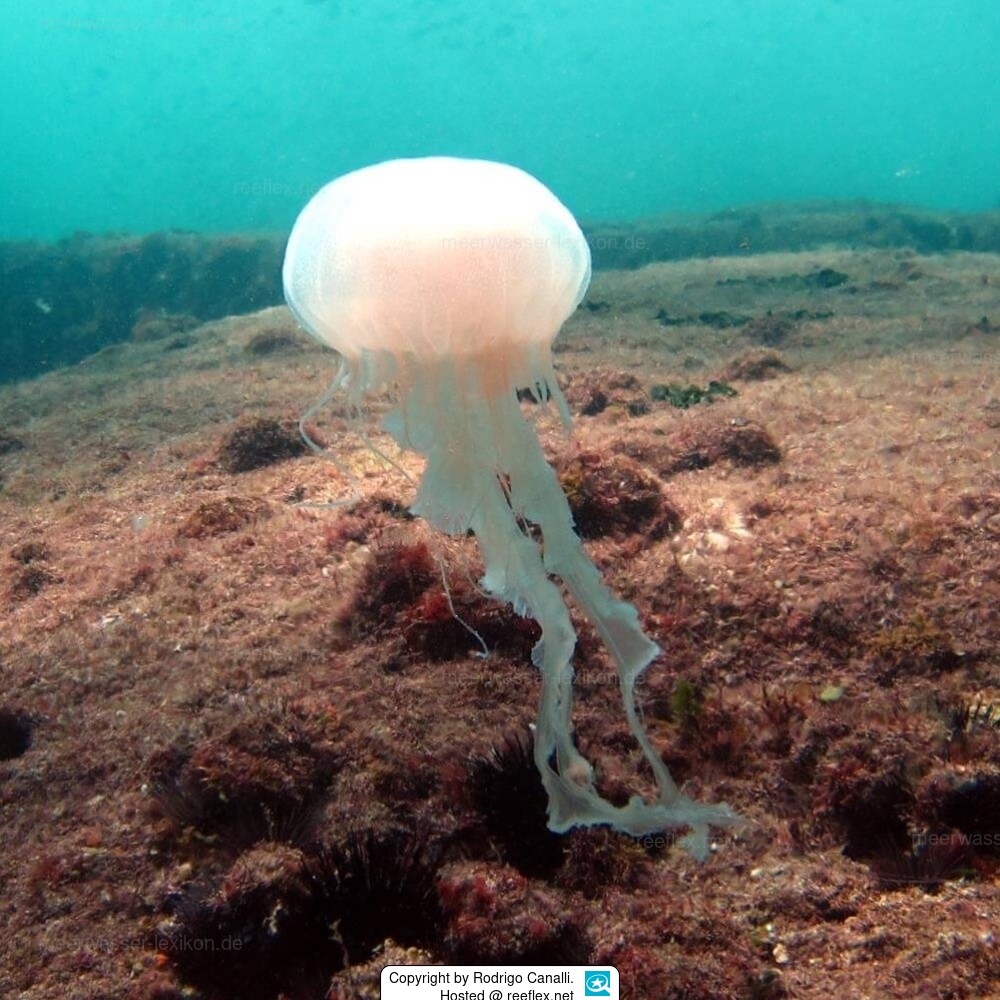
 Rodrigo Canalli, Brasilien


Info
Coloration: The background of the upper umbrella surface is usually milky white; some specimens have small brown spots on the upper umbrella surface and the oral arms, while others have a radial pattern of brownish triangles. In adult specimens, the number of tentacles varies: 3–5 tentacles per octant, with the central one designated as the primary tentacle, the two outer ones as secondary tentacles, and those in between as tertiary tentacles.
Umbrella diameter up to 25 cm
40 tentacles, 5 per octant
The exact tentacle length cannot be determined, but stings of up to 20 cm in length have been documented in humans, particularly in the states of São Paulo, Paraná, and Santa Catarina in the southeast.
Mass stings among long-distance swimmers
The first outbreak occurred on November 27, 2011, in the state of Paraná (southeastern Brazil) during a water sports competition with 60 participants and 10 cases of poisoning.
Those stung immediately experienced severe pain at the site of contact, erythematous and edematous plaques, as well as papules and piloerection at the lesions cramps and back pain, as well as chills, nausea, and vomiting. Cramps and back pain are common symptoms of muscle spasms
The skin lesions varied in shape and size, ranging from round to elongated or linear plaques with an urticarial appearance, measuring up to 15 cm in size.
Treatment for this type of poisoning involves immersion in chilled seawater due to its numbing effect (the use of chilled freshwater triggers the release of toxin from intact cells on the skin), vinegar baths or compresses (which also prevent the release of toxin from intact cells), and analgesics for persistent pain, which leads to good results.
A recent randomized study found that applying hot water (45 °C) for 20 to 30 minutes may be more effective than cold water.
The second incident occurred in Bertioga (state of São Paulo) during another swimming marathon on November 14, 2016, and affected 60 of 247 (24%) swimmers.
Competitive and recreational swimmers should always wear special protective clothing, especially in the summer in areas where Chrysaora lactea is found.
Synonym:
Chrysaora blossevillii Lesson, 1830 · unaccepted (synonym)
Dactylometra lactea L. Agassiz · unaccepted > junior subjective synonym (authority wrongly stated)
Umbrella diameter up to 25 cm
40 tentacles, 5 per octant
The exact tentacle length cannot be determined, but stings of up to 20 cm in length have been documented in humans, particularly in the states of São Paulo, Paraná, and Santa Catarina in the southeast.
Mass stings among long-distance swimmers
The first outbreak occurred on November 27, 2011, in the state of Paraná (southeastern Brazil) during a water sports competition with 60 participants and 10 cases of poisoning.
Those stung immediately experienced severe pain at the site of contact, erythematous and edematous plaques, as well as papules and piloerection at the lesions cramps and back pain, as well as chills, nausea, and vomiting. Cramps and back pain are common symptoms of muscle spasms
The skin lesions varied in shape and size, ranging from round to elongated or linear plaques with an urticarial appearance, measuring up to 15 cm in size.
Treatment for this type of poisoning involves immersion in chilled seawater due to its numbing effect (the use of chilled freshwater triggers the release of toxin from intact cells on the skin), vinegar baths or compresses (which also prevent the release of toxin from intact cells), and analgesics for persistent pain, which leads to good results.
A recent randomized study found that applying hot water (45 °C) for 20 to 30 minutes may be more effective than cold water.
The second incident occurred in Bertioga (state of São Paulo) during another swimming marathon on November 14, 2016, and affected 60 of 247 (24%) swimmers.
Competitive and recreational swimmers should always wear special protective clothing, especially in the summer in areas where Chrysaora lactea is found.
Synonym:
Chrysaora blossevillii Lesson, 1830 · unaccepted (synonym)
Dactylometra lactea L. Agassiz · unaccepted > junior subjective synonym (authority wrongly stated)

