




 ZooKeys

Info
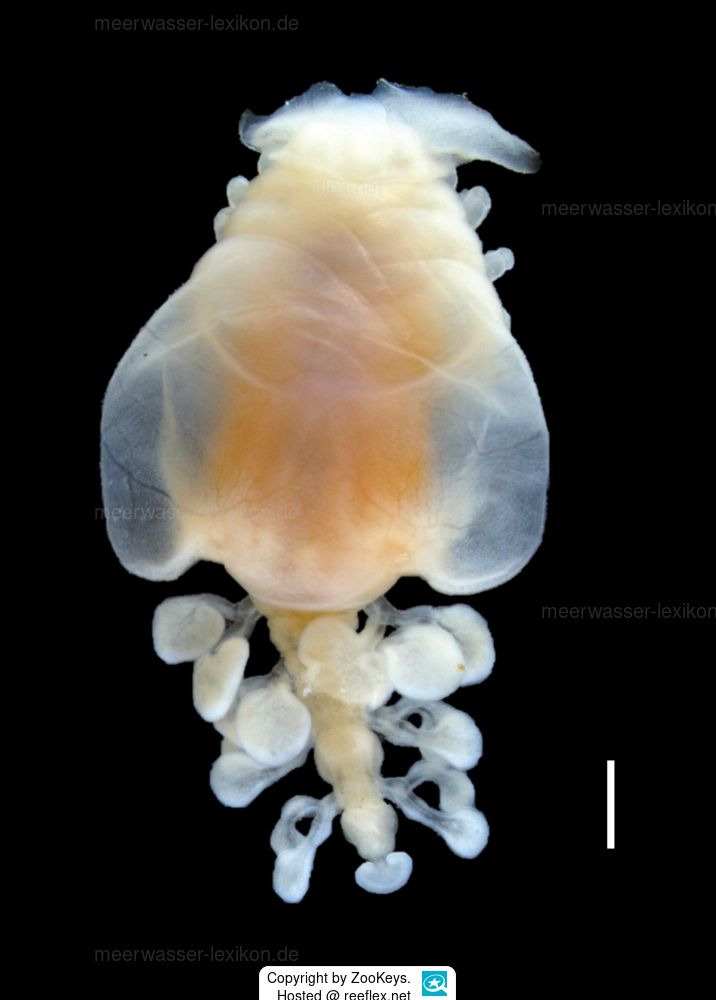
Athelges pileus lives as a parasite (Bopyrid) on the hermit crab Diogenes edwardsii and has been found on multiple occasions on the dorsal side of the pleon; it was discovered in 2023 in a basket trap set to catch whelks in the coastal waters of Sosogi, Wajima, Ishikawa Prefecture, Japan.
In two of the 349 hermit crabs examined, the pleon was infested by female Bopyrid isopods, one of which was accompanied by a male.
This is the second species of the genus Athelges known to parasitize the hermit crab Diogenes edwardsii; the other species is Bopyrissa pyriforma (Shiino, 1958), which lives in the gill cavity of decapods.
The photo shows a female Athelges pileus whose head is deeply embedded in the host’s thorax and is feasting on the hermit crab’s body fluids.
It is unknown whether the hermit crab can survive the parasitic infestation.
Etymology.
Derived from the Latin noun “pileus,” which refers to the pleotelson, which is shaped like a mushroom cap.
Reference:
Shinoda H, Fujita H, Toyota K, Nakano T, Shimomura M (2026)
A new species of Athelges (Crustacea, Isopoda, Epicaridea, Bopyridae) from Japan, with morphological and DNA barcode data.
ZooKeys 1270: 207-222. https://doi.org/10.3897/zookeys.1270.160197
This is an open access article distributed under the terms of the Creative Commons Attribution License (CC BY 4.0), which permits unrestricted use, distribution, and reproduction in any medium, provided the original author and source are credited.
In two of the 349 hermit crabs examined, the pleon was infested by female Bopyrid isopods, one of which was accompanied by a male.
This is the second species of the genus Athelges known to parasitize the hermit crab Diogenes edwardsii; the other species is Bopyrissa pyriforma (Shiino, 1958), which lives in the gill cavity of decapods.
The photo shows a female Athelges pileus whose head is deeply embedded in the host’s thorax and is feasting on the hermit crab’s body fluids.
It is unknown whether the hermit crab can survive the parasitic infestation.
Etymology.
Derived from the Latin noun “pileus,” which refers to the pleotelson, which is shaped like a mushroom cap.
Reference:
Shinoda H, Fujita H, Toyota K, Nakano T, Shimomura M (2026)
A new species of Athelges (Crustacea, Isopoda, Epicaridea, Bopyridae) from Japan, with morphological and DNA barcode data.
ZooKeys 1270: 207-222. https://doi.org/10.3897/zookeys.1270.160197
This is an open access article distributed under the terms of the Creative Commons Attribution License (CC BY 4.0), which permits unrestricted use, distribution, and reproduction in any medium, provided the original author and source are credited.

