


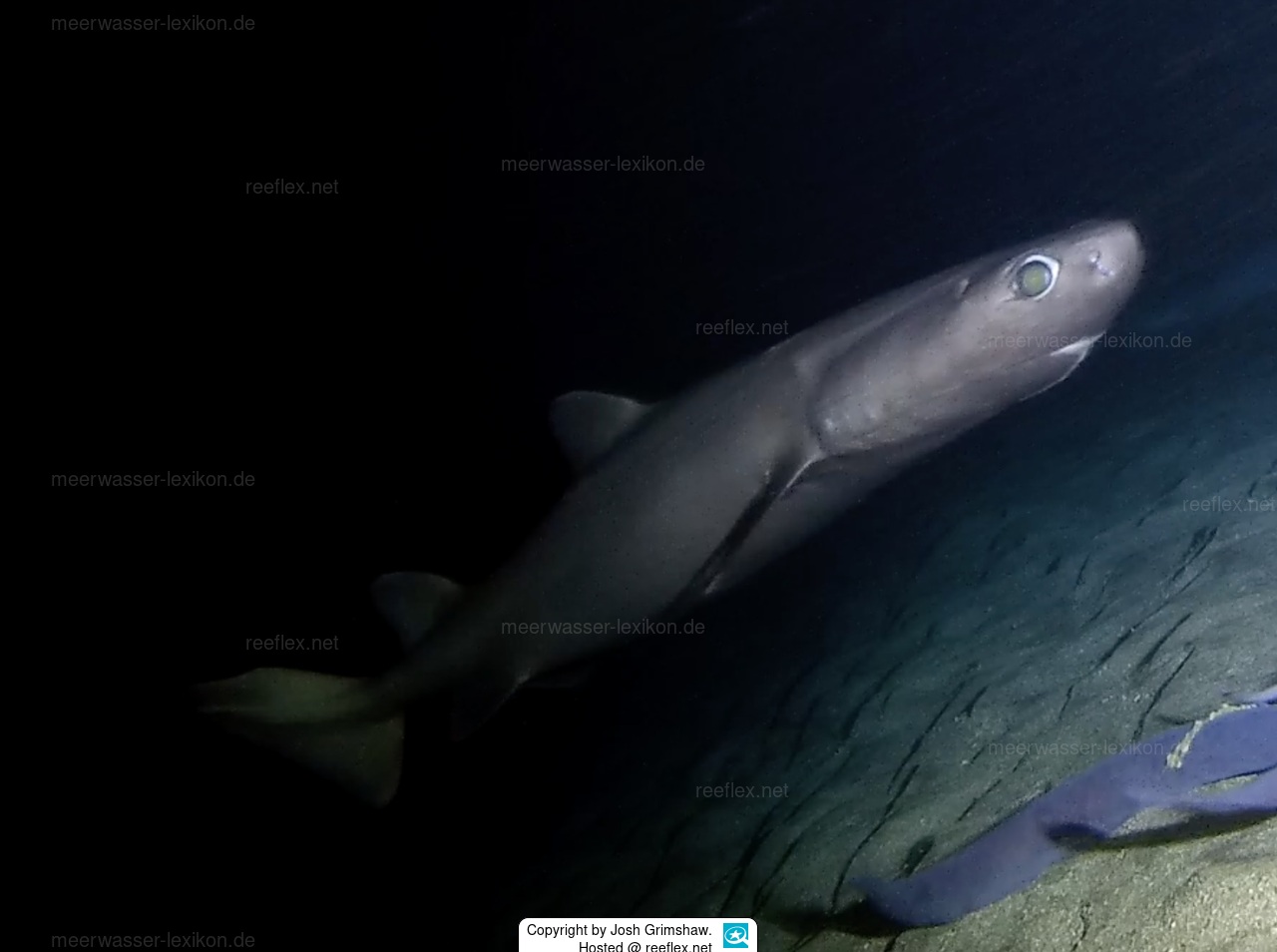
 Josh Grimshaw, Neuseeland

Info
The chocolate shark is a deep-sea shark with a short, blunt snout, fleshy lips, large, triangular, serrated teeth in the lower jaw, and small, narrow, awl-shaped teeth with smooth edges in the lower jaw; it has no fin spines.
This species is the largest known bioluminescent vertebrate and the first known shark whose dorsal fins glow entirely.
The shark is uniformly violet-black to dark gray or brown, with light-colored lips, green eyes, and light-colored or translucent trailing edges on its fins.
Dalatias licha feeds on small bottom-dwelling sharks such as lantern sharks, swallowtail sharks, rays, and cat sharks, as well as on bottom-dwelling bony fish, crustaceans, and cephalopods.
Chocolate sharks have asymmetrical teeth; the teeth in the upper jaw are small, narrow, and awl-shaped with smooth edges.
The larger teeth in the lower jaw stand upright and are broadly triangular, with serrated tips and overlapping bases.
This arrangement allows them to tear chunks of flesh from large, fast-swimming epipelagic fish—similar to their relatives, the cookie-cutter sharks.
This shark species occurs singly or in small schools.
Males reach sexual maturity at a total length (TL) of ~100 cm, females at a TL of ~120 cm; the size at birth is 30–40 cm TL.
Reproduction is lecithotrophic and viviparous, presumably asynchronous, with litter sizes ranging from 3 to 16 pups (average 6–8).
This bioluminescent shark emits light from its underside to create backlighting, which may serve to illuminate the seafloor while searching for prey, or to stealthily approach its prey by taking advantage of the camouflage provided by the backlighting before striking quickly once it is close enough.
Synonym:
The species name “licha” is derived from “La Liche” according to Broussonet, 1784, the first description of this species.
We would like to extend our heartfelt thanks to Josh Grimshaw, New Zealand, who kindly provided us with one of the few photos of a living chocolate shark.
This species is the largest known bioluminescent vertebrate and the first known shark whose dorsal fins glow entirely.
The shark is uniformly violet-black to dark gray or brown, with light-colored lips, green eyes, and light-colored or translucent trailing edges on its fins.
Dalatias licha feeds on small bottom-dwelling sharks such as lantern sharks, swallowtail sharks, rays, and cat sharks, as well as on bottom-dwelling bony fish, crustaceans, and cephalopods.
Chocolate sharks have asymmetrical teeth; the teeth in the upper jaw are small, narrow, and awl-shaped with smooth edges.
The larger teeth in the lower jaw stand upright and are broadly triangular, with serrated tips and overlapping bases.
This arrangement allows them to tear chunks of flesh from large, fast-swimming epipelagic fish—similar to their relatives, the cookie-cutter sharks.
This shark species occurs singly or in small schools.
Males reach sexual maturity at a total length (TL) of ~100 cm, females at a TL of ~120 cm; the size at birth is 30–40 cm TL.
Reproduction is lecithotrophic and viviparous, presumably asynchronous, with litter sizes ranging from 3 to 16 pups (average 6–8).
This bioluminescent shark emits light from its underside to create backlighting, which may serve to illuminate the seafloor while searching for prey, or to stealthily approach its prey by taking advantage of the camouflage provided by the backlighting before striking quickly once it is close enough.
Synonym:
The species name “licha” is derived from “La Liche” according to Broussonet, 1784, the first description of this species.
We would like to extend our heartfelt thanks to Josh Grimshaw, New Zealand, who kindly provided us with one of the few photos of a living chocolate shark.

