





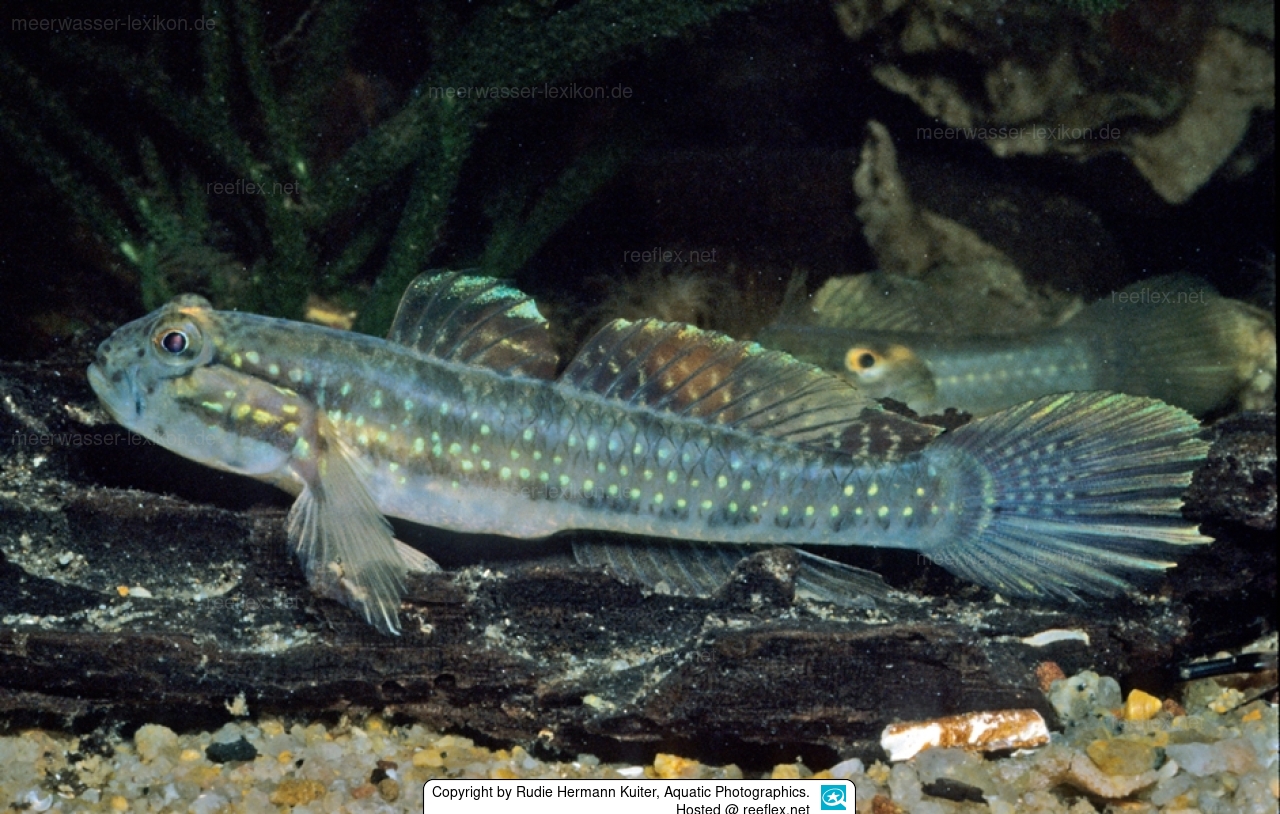
 Rudie Hermann Kuiter, Aquatic Photographics, Australien


Info
Arenigobius frenatus (Günther, 1861)
Arenigobius frenatus inhabits burrows in seagrass beds and mangroves in estuaries, bays, and local lagoons on soft substrates (Bray 2017). In these self-dug burrows, it lives in breeding pairs (Bray 2017), with the females laying their eggs in the burrow during the spawning season (D. Hoese and H.K. Larson, personal communication 2024).
Arenigobius frenatus is carnivorous and feeds primarily on benthic invertebrates (Bray 2017).
The head appears slightly compressed, and the snout is short and blunt.Arenigobius frenatus has a terminal mouth that extends to just below the center of the eye.
The eyes of the bridled goby are large and set close together.The tail is slightly pointed to slightly rounded, and the pectoral fins are large, slightly pointed to slightly rounded.
The head features gray-brown and black spots, and there are about 8 irregular bands on the sides.A horizontal stripe is clearly visible on the side of the head, extending from the eyes across the top of the gill cover.There is usually a vertical, dark stripe below the eyes.
Synonyms:
Acentrogobius frenatus (Günther, 1861) · unaccepted (synonym)
Gobius frenatus Günther, 1861 · unaccepted
Gobius semifrenatus MacLeay, 1881 · unaccepted
Arenigobius frenatus inhabits burrows in seagrass beds and mangroves in estuaries, bays, and local lagoons on soft substrates (Bray 2017). In these self-dug burrows, it lives in breeding pairs (Bray 2017), with the females laying their eggs in the burrow during the spawning season (D. Hoese and H.K. Larson, personal communication 2024).
Arenigobius frenatus is carnivorous and feeds primarily on benthic invertebrates (Bray 2017).
The head appears slightly compressed, and the snout is short and blunt.Arenigobius frenatus has a terminal mouth that extends to just below the center of the eye.
The eyes of the bridled goby are large and set close together.The tail is slightly pointed to slightly rounded, and the pectoral fins are large, slightly pointed to slightly rounded.
The head features gray-brown and black spots, and there are about 8 irregular bands on the sides.A horizontal stripe is clearly visible on the side of the head, extending from the eyes across the top of the gill cover.There is usually a vertical, dark stripe below the eyes.
Synonyms:
Acentrogobius frenatus (Günther, 1861) · unaccepted (synonym)
Gobius frenatus Günther, 1861 · unaccepted
Gobius semifrenatus MacLeay, 1881 · unaccepted

