Anzeige
Fauna Marin GmbH Mrutzek Meeresaquaristik Kölle Zoo Aquaristik ICP Aqua Medic

Ctenactis albitentaculata White-Tentacled Tongue Coral, Mushroom Coral

Ctenactis albitentaculata is commonly referred to as White-Tentacled Tongue Coral, Mushroom Coral. Difficulty in the aquarium: простой. A aquarium size of at least 200 Liter is recommended. Toxicity: Toxic hazard unknown.


Profilbild Urheber Dr. Paddy Ryan, USA

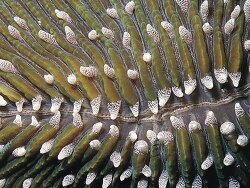
Ctenactis albitentaculata (Order Fungiidae), Kadavu, Fiji ,Copyright Paddy Ryan


Courtesy of the author Dr. Paddy Ryan, USA . Please visit www.ryanphotographic.com for more information.

Uploaded by Muelly.

Image detail


Profile

lexID:
4269 
AphiaID:
288874 
Scientific:
Ctenactis albitentaculata 
German:
Weißtentakel Pilzkoralle 
English:
White-Tentacled Tongue Coral, Mushroom Coral 
Category:
Крупнополипные Жёсткие Кораллы 
Family tree:
Animalia (Kingdom) > Cnidaria (Phylum) > Anthozoa (Class) > Scleractinia (Order) > Fungiidae (Family) > Ctenactis (Genus) > albitentaculata (Species) 
Initial determination:
Hoeksema, 1989 
Occurrence:
Andaman and Nicobar Islands, Australia, Banda Sea, Bunaken, Central Pazific, Fiji, Guam, Indonesia, Japan, Java, Kiribati, Lembeh Strait, Malaysia, Marschall Islands, Micronesia, Naoero (Nauru), New Caledonia, New Guinea, Northern Mariana Islands, Oceania, Palau, Papua New Guinea, Philippines, Solomon Islands, Sulawesi, Sumatra, Taiwan, The Bangai Archipelago, Timor, Togean Islands, Tuvalu, Vanuatu, Wallis and Futuna, Western Pacific Ocean 
Marine Zone:
Subtidal, sublittoral, infralittoral, deep zone of the oceans from the lower limit of the intertidal zone (intertidal) to the shelf edge at about 200 m water depth. neritic. 
Sea depth:
0 - 30 Meter 
Habitats:
Coral reefs, Gravel soil, Reef roofs, Reef canopies, Reef flats, Reef-associated, Rubble floors, Sandy sea floors, Seawater, Sea water 
Size:
up to 11.81" (30 cm) 
Temperature:
75.2 °F - 84.2 °F (24°C - 29°C) 
Food:
Dustfood , Phytoplankton, Plankton, Zooplankton, Zooxanthellae / Light 
Tank:
44 gal (~ 200L)  
Difficulty:
простой 
Offspring:
Possible to breed 
Toxicity:
Toxic hazard unknown 
CITES:
Appendix II ((commercial trade possible after a safety assessment by the exporting country)) 
Red List:
Endangered (EN) 
Related species at
Catalog of Life
:
 
More related species
in this lexicon
:
 
Author:
Publisher:
Meerwasser-Lexikon.de
Created:
Last edit:
2026-08-10 20:34:11 

Captive breeding / propagation

The offspring of Ctenactis albitentaculata are possible. Unfortunately, the number of offspring is not large enough to cover the demand of the trade. If you are interested in Ctenactis albitentaculata, please ask your dealer for offspring. If you already own Ctenactis albitentaculata, try breeding yourself. This will help to improve the availability of offspring in the trade and to conserve natural stocks.

Info

Ctenactis albitentaculata Hoeksema, 1989

“From Veron, J.E.N. Corals of the World.”

Characters: Polyps are elongate, with an axial furrow extending most of the polyp length. Several mouths are arranged along the axial furrow but do not occur outside the furrow. Septal teeth are long and tapered. Tentacles are usually partly extended during the day.

Colour: Pale brown with conspicuous white tentacles.

Habitat: Shallow reef environments.

Abundance: Sometimes common.

Similar species: Ctenactis echinata

Classification: Biota > Animalia (Kingdom) > Cnidaria (Phylum) > Anthozoa (Class) > Hexacorallia (Subclass) > Scleractinia (Order) > Fungiidae (Family) > Ctenactis (Genus) > Ctenactis albitentaculata (Species)

Source reference: Veron (2000). Taxonomic reference: Hoeksema (1989). Additional identification guide: Nishihira (1988).

External links

  1. Corals of the World by Charlie Veron (en). Abgerufen am 07.08.2020.
  2. researchgate (en). Abgerufen am 10.08.2026.

Pictures

Commonly


Husbandry know-how of owners

0 husbandary tips from our users available
Show all and discuss