


 Dr. Sergey V. Bogorodsky, Russland


Info
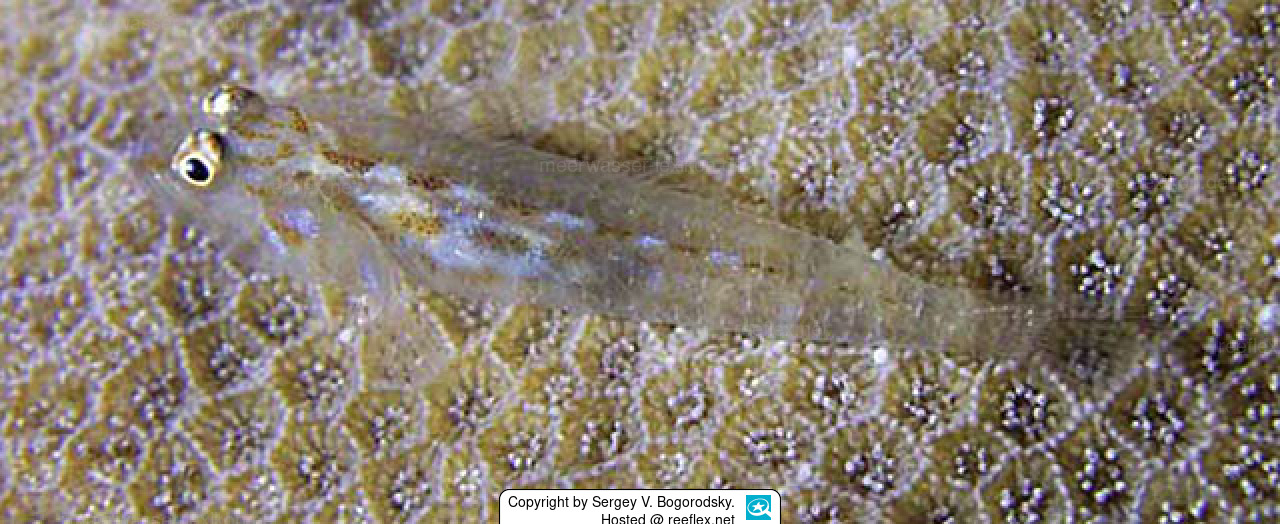
Pleurosicya plicata is a semi-transparent goby with a pale pink to reddish-orange coloration, often covered with tiny spots and a brown to reddish stripe on the side of its snout.
The head, neck, midline of the belly, and chest have no scales, and the gill opening of this small goby extends at least to the edge of the preoperculum.
Pleurosicya plicata inhabits hard sponges at medium depths, usually 10 meters or more, but probably depending on the occurrence of certain sponges.
In the Pacific, this species lives on sponges found on reef flats, in lagoons, and in reef channels (Myers 1999).
In the Red Sea, it occurs on hard corals, Favia, and Goniastrea, at depths of usually more than 10 m (Kuiter and Tonozuka 2001).
This preference for different habitat types by populations in different parts of the range suggests the existence of two separate species.
Etymology:
The species name “plicata” comes from Latin and means “folded,” referring to the folds of the narrow pelvic fin lobes.
The head, neck, midline of the belly, and chest have no scales, and the gill opening of this small goby extends at least to the edge of the preoperculum.
Pleurosicya plicata inhabits hard sponges at medium depths, usually 10 meters or more, but probably depending on the occurrence of certain sponges.
In the Pacific, this species lives on sponges found on reef flats, in lagoons, and in reef channels (Myers 1999).
In the Red Sea, it occurs on hard corals, Favia, and Goniastrea, at depths of usually more than 10 m (Kuiter and Tonozuka 2001).
This preference for different habitat types by populations in different parts of the range suggests the existence of two separate species.
Etymology:
The species name “plicata” comes from Latin and means “folded,” referring to the folds of the narrow pelvic fin lobes.


