

 Dr. Bart Hazes, Kanada


Info
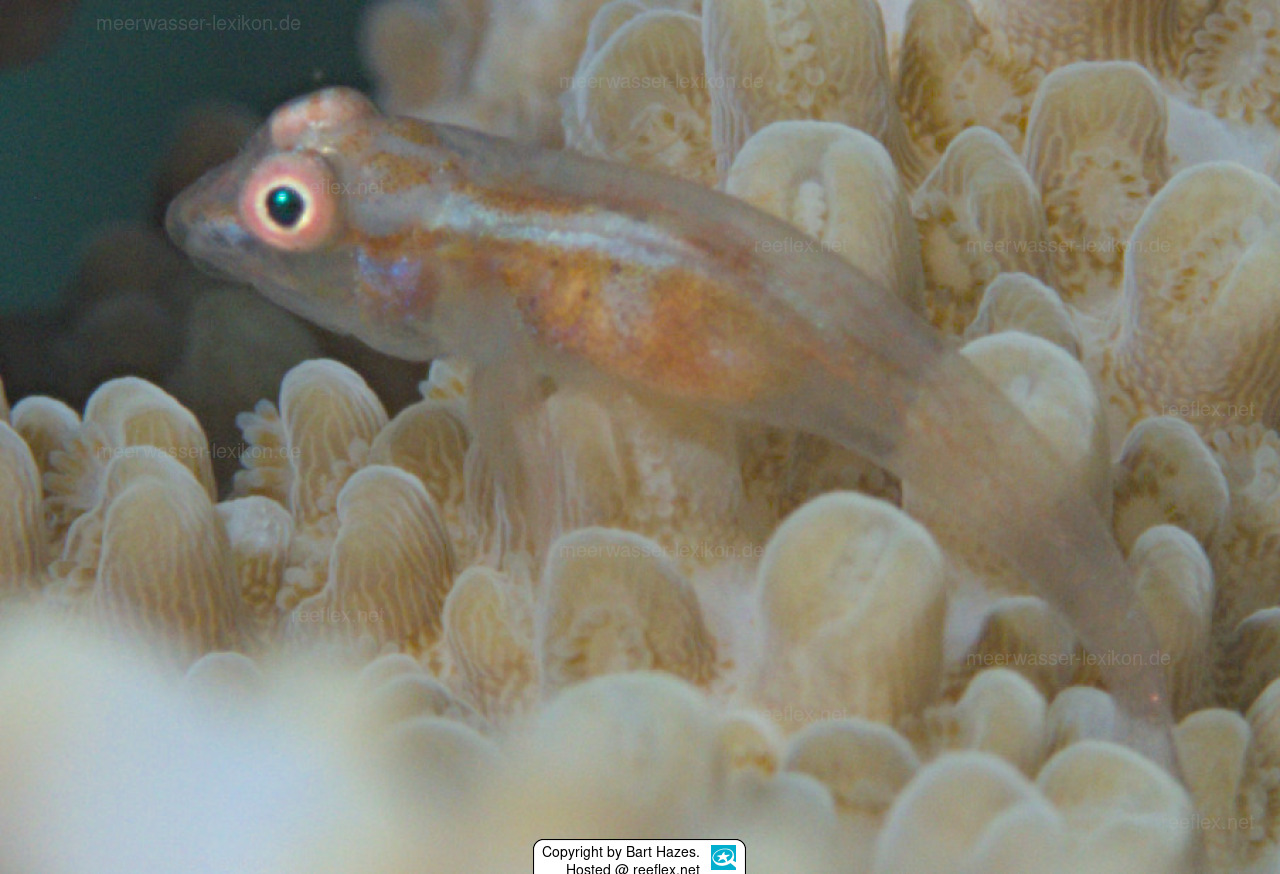
Despite being very widespread, there are only a few photos of the small ghost goby. We would like to express our sincere thanks to Dr. Bart Hazes for the first photo!
One possible reason for the scarcity of photos of Pleurosicya fringilla is that this small goby lives among branching corals, particularly Acropora formosa, Acropora grandis, and Pocillopora eydouxi (Allen and Erdmann 2012), and therefore seems difficult to capture on camera.
Little else is known about the life cycle and reproductive strategies of Pleurosicya fringilla.
Pleurosicya fringilla is a very small, semi-transparent goby with fine dark spots, a brown stripe on the side of the snout, a brown stripe along the front midline, and a brown spot in the upper part of the gill cover.
Dr. Helen Larson recorded the following brief description of Pleurosicya fringilla for a specimen from Lizard Island, Great Barrier Reef:
A specimen collected from a brown staghorn Acropora coral reef near Lizard Island was transparent and had fine brown speckles over the entire peritoneum, the back of which was silvery-white and the rest yellowish (below the melanophores)
A brown stripe ran from the front of each eye to the tip of the snout, where it met the stripe from the other eye. Behind the eyes, the color was yellowish-orange, and there were indistinct brownish areas above the upper operculum.
A brown stripe ran from the middle of the back along the midline of the neck to the front and faded behind the eyes into a yellowish color. Below the stripe, there was a yellowish-orange internal pigment. The eyes were silvery to golden.
When observed in the field, this species may appear translucent, with the body color matching that of the Acropora on which it lives.
Visually similar species: Pleurosicya prognatha Goren, 1984
Etymology. The species name is derived from the Latin word “fringilla,” meaning “finch,” and refers to the “tiny, bird-like appearance” of this goby.
One possible reason for the scarcity of photos of Pleurosicya fringilla is that this small goby lives among branching corals, particularly Acropora formosa, Acropora grandis, and Pocillopora eydouxi (Allen and Erdmann 2012), and therefore seems difficult to capture on camera.
Little else is known about the life cycle and reproductive strategies of Pleurosicya fringilla.
Pleurosicya fringilla is a very small, semi-transparent goby with fine dark spots, a brown stripe on the side of the snout, a brown stripe along the front midline, and a brown spot in the upper part of the gill cover.
Dr. Helen Larson recorded the following brief description of Pleurosicya fringilla for a specimen from Lizard Island, Great Barrier Reef:
A specimen collected from a brown staghorn Acropora coral reef near Lizard Island was transparent and had fine brown speckles over the entire peritoneum, the back of which was silvery-white and the rest yellowish (below the melanophores)
A brown stripe ran from the front of each eye to the tip of the snout, where it met the stripe from the other eye. Behind the eyes, the color was yellowish-orange, and there were indistinct brownish areas above the upper operculum.
A brown stripe ran from the middle of the back along the midline of the neck to the front and faded behind the eyes into a yellowish color. Below the stripe, there was a yellowish-orange internal pigment. The eyes were silvery to golden.
When observed in the field, this species may appear translucent, with the body color matching that of the Acropora on which it lives.
Visually similar species: Pleurosicya prognatha Goren, 1984
Etymology. The species name is derived from the Latin word “fringilla,” meaning “finch,” and refers to the “tiny, bird-like appearance” of this goby.

